Saturday, August 11, 2012
Shark Tacos:Tragedy and Triumph
I am a huge proponent of “thinking globally and acting locally.” This mentality inspires change and has far reaching impacts. With Shark Week approaching ,sharks are A List celebs making appearances in media across the globe (As they should be because they are AWESOME). Discovery has teamed up with some heavy hitters in the conservation world to make this year’s shows even better than ever with a strong focus on education and conservation.
The MexiBBQ in Astoria, New York has decided to celebrate Shark Week by serving SHARK TACOS! Yes, grilled bull shark tacos. I wrote to the restaurant and informed them that bull shark is listed as a near threatened species on the ICUN red list and that serving shark is unnecessary and unhealthy for people and the environment. I received a reply that assured me that they are using mako shark not bull shark, as if this remedied the whole situation. They also stated that they were “We respect and obey all environmental restrictions and thank you for pointing it out...” They probably honestly believe that this is what they are doing and do no understand that shark should not be served for any reason.
The food review has been circulating the Internet and no doubt they are feeling some pressure to make a more educated decision about their menu items. Not knowing is no longer an excuse. Do you homework. Sharks populations are being decimated across the globe, they do not need to be served in tacos or anything else. There is no shortage of food options for fancy restaurants in New York ,so there is absolutely no reason to offer it.
It is quite easy to point the finger at countries in Asia and other parts of the world, but the reality is that shark is being killed and served in our own backyards. The mako they are purchasing is probably being caught off New York, as they are regular catches in the fishing tournaments held there.
Just as I was finishing this blog I received an email from MexiBBQ stating, “In light of the recent awareness shown to us MexiBBQ will not serve Mako Shark. We were not aware that this breed of shark was on the endangered species list, and we have no intention of serving any fish that may become extinct. We apologize if we showed insensitivity to this matter.”
The rush of calls and emails from concerned ocean advocates made a difference. We all have a voice and if we speak with intelligence and compassion that voice can be very powerful. Thank you MexiBBQ for making a change to better help our oceans.


Sunday, August 5, 2012
Shallow Water Sun Tans and Snacks: Lemon Sharks on the Hunt
The research done at the Bimini Biological Field Station (Sharklab) has found that juvenile lemon sharks use the shallow flats to hunt on low tides. Different research projects have used tracking and visual accounts to record hunting, feeding and social behaviors in the regions. Juvenile lemon sharks use the mangroves as a nursery; the shallow waters reduce the risk of large predators being present and also reduce the area that prey has to escape.

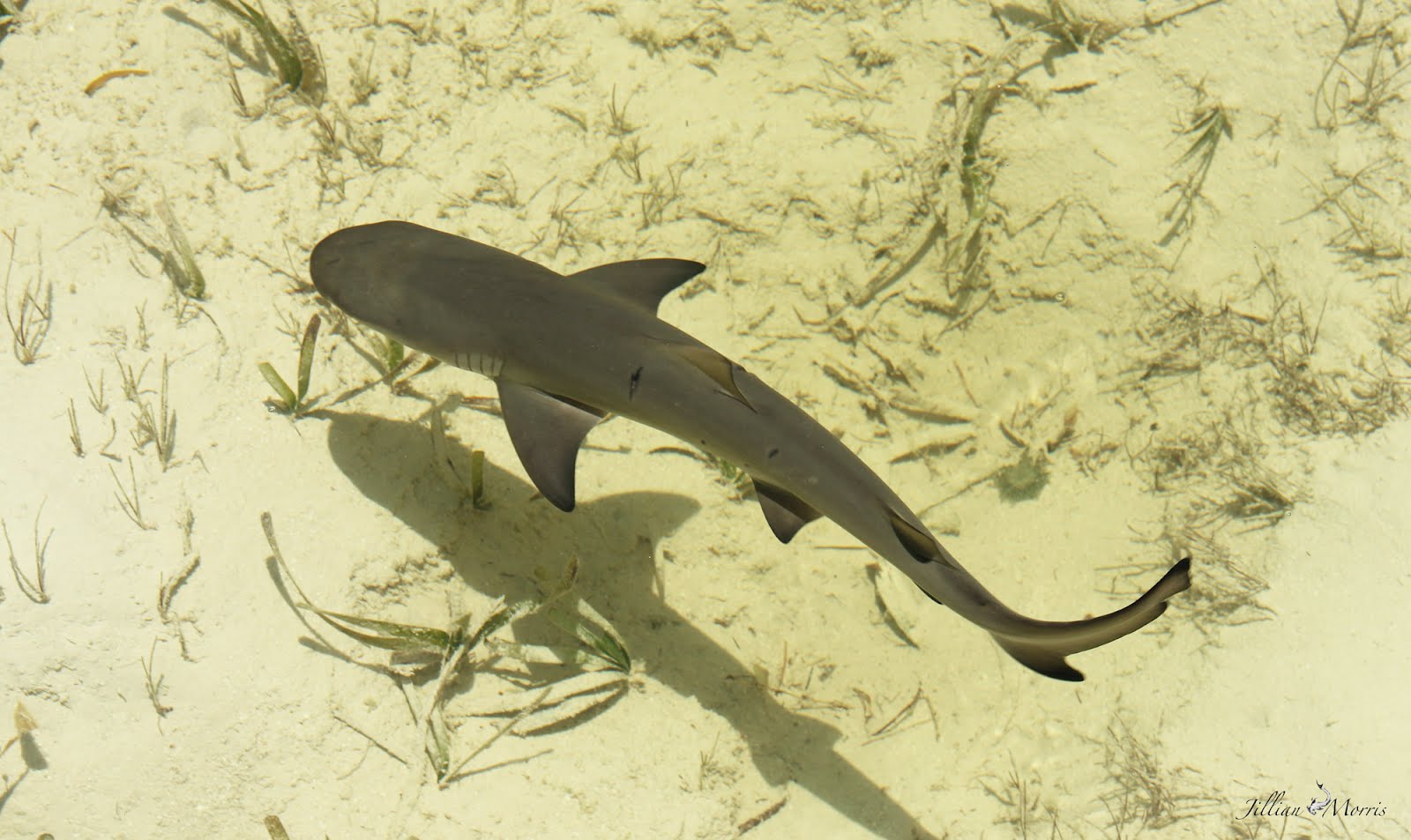

Duncan and I recently joined Sharklab director Dr. Tristan Guttridge to film and do observations from a tower erected in the shallows. We arrived as the tide was falling and watched as one, two and then up to ten juveniles moved around our viewing perch. As the tide dropped so did the size of the sharks making use of the area. Pups born this year were working the patches of sea grass looking for small fish and crabs. Amazing to see a wild shark detect possible prey and use electroreception, scent and sight to track it down.


We watched patiently for hours and recorded behaviors, keeping an eye out specifically for sharks that had transmitters on them. Duncan and I were hoping to capture a predation event on camera and four hours into our watch we lucked out. As closing time was fast approaching we watched as a lemon shark, most likely born in the spring, worked an area of sea grass right in front of us. His large circles quickly tightened and his movements became sharper. Whatever was hiding in the sea grass had peaked his interest and he seemed determined to make a meal of it. We watched, cheering on the shark to, “ get it, get it, “ when finally a small shape darted from its hiding spot and the shark snagged it. The small fish dangled briefly from the clenched jaws of the perfect miniature predator before disappearing for good. Exciting for us to capture on camera, but even more incredible to witness.

We see sharks feeding all the time, but either we are generating the prey source or someone else is. We watch the sharks eat, but we do not get to appreciate the finely tuned hunting skills that have been perfected over years of evolution. We give presentations and tours, explaining to people how shark senses work and what happens when they go in hunt mode. Watching it brings a whole new level of appreciation for just how awesome these animals are.
As we packed up the gear and climbed down from our perch, we left with an ever- increasing enthusiasm for these incredible ocean predators that we love and are endlessly in awe of. Witnessing these behaviors also enhances our resolve to help the mangrove areas that are absolutely vital for these juveniles. Without their protection and the opportunity to feed in the shallow areas surrounding them, adult lemon shark populations will suffer drastically as will the other species of fish, conch and lobster that rely on the mangroves. Bimini is working hard to protect its natural resources despite the best efforts of outside forces to destroy the natural environment in order to create an entertainment space for the rich travelers that cannot possibly travel to an island without a golf course or casino.


Hopefully the marine protected area that is in progress of being finalized will ensure that at least some of these tiny sharks will have an ecosystem to thrive in and return as adults to give birth to the next cohort. Check out the SHARKLAB and Bimini MPA for more information on how you can help the sharks of Bimini and the Bahamas.
Friday, July 27, 2012
Shark Killing Vigilante- Just What the World Needs
Enio Regis Biela is a self-proclaimed vigilante in a race to protect the human race from its eminent doom at the hands or mouths of sharks. He believes that in order for people to sleep soundly in their beds, he must rid the ocean of man-eating sharks Yes, that’s right, this man has gone on a shark- killing spree because he believes sharks will wipe out the human race if we do not wipe them out first. Nope, I am not making this up, but I wish I were. Shocking that such blatant stupidity still runs rampant in a world where environmental issues have become mainstream. I do not believe that ignorance is the sole culprit at the heart of this ridiculous situation. He may be blind to the reality of global shark devastation, but I do believe that he is completely ignorant. Ignorance is no longer a viable excuse in my book. Not everyone may be aware of the extent to which sharks are in trouble, but I am sure they have caught a news show, internet post or magazine article at some point. The world is a small place and the Internet is continuously making it smaller. We have access to a great deal of knowledge, albeit that some is complete crap, but we do have access.
I wonder if Enio believe his own conviction or if it is a ploy for attention. Maybe he is doing it to spite some, “tree hugging granola eating hippies that care about the planet?” Whatever the reason the outcome is unacceptable. Along with conservationists I am guessing that local fisherman are probably disgusted with the waste. I know in Bimini the locals were angered by weekend warriors cutting out the jaws of bull sharks and then throwing them back. They were wasting the whole animal that could feed a lot of people. I am not a supporter of fishing for sharks at all, but if the animal is dead at least make use of it.
I am sure by now, with the ever-growing power of social media, Mr. Biela is getting an ear full about his actions. I hate Facebook, but I also love it for this reason. I can reach out to a lot of my passionate friends who may not know a lot about sharks, but will definitely have something to say about this disgrace. Even if you do not want to jump in and swim with sharks, most people do not want to see them tortured. Look how small the sharks at his feet are. They are juvenile bull sharks that will never get the chance to reach breeding age. His conquest will no longer be quiet, as the release of this image has no doubt catalyzed a campaign against his stupidity and blatant disregard for life and the oceans.
Below is my message to Mr. Biela. I was not able to send it because his page no longer exists. In less than 24 hours I imagine the spread of his disgusting action has caused him to rethink, at least his heroic exploits via the Internet. We will be watching for his page to go live again and will not stop spreading the word.
Mr. Biela:
I am a concerned ocean advocate writing to you in regards to pictures that were posted on the Internet. Sharks are vital for our oceans survival and by no means is killing them the answer. If human were truly in danger of super predation by sharks then swimmers around the world would be wiped out. Sharks do not consider humans food. This is a scientific fact. Yes, attacks do happen, but most can be explained and possibly prevented. The media, leaving the truth out because it is not as flashy, exaggerates the stories. The juvenile bull sharks you have slaughtered pose no threat to humans, so in fact you are contradicting the goal of your vigilante mission. You are teaching those around you that merciless slaughter is acceptable. You have the right to hate sharks for whatever reason you deem worthy, although I doubt you have any reason ground in reality, you do not have the right to slaughter these animals.
I hope you think about all the letters and statements that you are undoubtedly receiving and ask yourself if this is really how you want to live your life. I have no doubt that you solo quest to save humans will be halted, but it would be an amazing thing if you chose to stop on your own accord.
Tuesday, July 17, 2012
Dangerous Waters for Sharks in Western Australia

I have quite a few friends that work in Western Australian media and have received emails regarding the recent shark events that have been happening. I respect greatly their want of a different perspective, other than the hunt down and kill all white pointers methodology that rears its ugly head. As representatives of the media it is their job to cover the news, but they want to understand what is happening and why, as to not get caught up in the monster mayhem.
My first response is that yes, there are sharks in the oceans. There are lots of sharks in oceans all over the world. The human race is doing an outstanding job at reducing their numbers drastically, but they are still there. Each day millions of people venture into the ocean for a swim, dive, surf and each day millions of people have no issues with sharks. Most do not even realize that there are sharks in their vicinity and I am doubtful that many even think about sharks.
Sharks are curious and when there is a foreign object introduced into their environment it is worth further exploration for the possibility of it being a prey item. If humans had to hunt and work hard for every meal, we too would be more observant of our surroundings and the happenings in them. When I speak to school groups and the question about shark attacks comes up I ask the kids this: if a new student walked into the cafeteria would you turn and look? Would you wonder who they were and what they were doing? I can ask adults a similar question: if you are sitting at your local watering hole and new face appears doesn’t everyone pause for a moment and assess them? It is a natural reaction among most animals, humans included, to respond to a new stimulus introduced in your environment. We do this all the time, but if a wild animal does it than they must be man-eating monsters with the sole mission of wiping out the human race. Way too many horror movies!
I am not claiming to be an expert on Australian sharks or sharks in general, but I do know a thing or two about shark behavior and migratory movement. Great whites, “white pointers,” are a highly migratory species of shark traveling thousands of miles each year. They travel for mating purposes and following optimum food sources. The white sharks return to Isla Guadalupe and the Farallon Islands from August to December to feed on juvenile and inexperienced elephant seals. If you had to hunt for every meal rather than ordering off a menu or walking to the fridge, wouldn’t you would follow the food too? This is not rocket science, but really common sense.
The human race slaughters a mere 100 million sharks a year and not to belittle the tragedy of human deaths that have occurred, but the numbers are not even comparable. If sharks wanted to consume humans as a food source then attacks would not be bite and runs, but instead be feeding events. Globally thousands of people would fall prey to these animals, if this were the reality. We are not on their menu. As food fish move towards shore sharks will follow them. We see the great migration of sharks each early spring in South Florida as the move along the eastern coast following shoals of fish. This is a logical explanation for their aggregation and a pretty remarkable sight to witness. If you chose to swim or surf in schools of baitfish then there might be issues. Would you take a stroll through a group of isolated juvenile zebras or antelopes on the Serengeti? No, that would be crazy right? Think about it? If you put yourself in the area of a massive apex predator that is looking for its next meal then you might find yourself as an item of interest. I grew up in Maine and people always go to the dump to see the black bears. People take donuts and other goodies and dangle them out of the car window for pictures. When the bear attacks, the people are considered idiots. A person swimming through schooling baitfish or water where fishermen are dumping scraps gets attacked and it is the shark’s fault? Really?
I have been in a shark cage in less than clear water and have looked up at a, “ seal” made out of carpet. It definitely looks like a seal, but I know it is not. A shark cruising in the area will no doubt come check it out on the off chance that it is a meal. Great whites do not have hands like we do and the element of surprise is important when trying to reduce the likelihood of a fight or the prey escaping. They move in hard and will use their mouths to determine whether the item is food or not. This is unfortunately a bite first and ask questions later situation. In most cases they let go, but human flesh is delicate in the jaws of a massive animal and severe damage is most usually the end result.
Because the attacks seem to be happening with more frequency people are assuming that there are more sharks and acting as thought this is a terrible revelation. According to the Australian Shark Attack File there have been 2 shark related fatalities in 2012 and there were only four in 2011. The news would make it seem as though hundreds of people were being decimated at the hands of a rogue man hunting white pointer. We should all be thrilled that there are more sharks, but in reality this is not likely the case. We are removing their food source at a devastating rate with commercial fishing and the slaughter of seals and sea lions in parts of the world. These animals are working hard to survive and may be taking greater risks at feeding opportunities. Moving close into shore with people, boats and pollution is a great risk for their animals, but it must be deemed worthwhile in an attempt to find nourishment. There are also more people going into the ocean as the human population continues to explode. These explanations are logical, but not nearly as exciting as sending people on shark killing missions of revenge. As I write this, the Western Australia government has issued a shark hunt to kill after the most recent incident. The mindless slaughter of a CITES protected animal is certainly not the answer.
The thought of removing great whites from the protected species list in Australian waters is absurd. Western Australia Fisheries Minister, Norman Moore has stated that he agrees to the removal if the government consents. These animals are in a desperate race against time and we are already doing a fantastic job at killing them off, why on earth would we make it even easier to continue the exploitation of these ocean guardians? Enjoy a big fish dinner? Without sharks you won’t enjoy much of anything from the sea? We need sharks. Our oceans need sharks. Australia’s waters are dangerous, for sharks that is.
Monday, July 2, 2012
Why Are We Teaching Kids to Kill Sharks?
My last blog highlighted a 12 year old boy that is speaking up on behalf of sharks; this blog is about encountering two different boys on the same day that were attempting to harass or kill a shark. We were able to stop one and actually get the whole group excited about sharks. It is amazing the impact that just five minutes of education can have.
On Sunday I was out boating with some friends just off West End Grand Bahama and we stopped at a small cay to enjoy the view and chat with some other boaters. Some guys were fishing in the flats and we really didn’t think anything of it. Our friend had mentioned that they see black tip sharks and nurse sharks out there, so we were hoping to get a glimpse. There were hound fish around, but not much else. We soon learned that they were catching hound fish to use for shark fishing bait. As this conversation started, Duncan and I were standing out in the water enjoying a good wallow and avoiding the army of mosquitoes. I was thrilled to overhear my friend, now an avid shark advocate and one of my dive students, explain why they should not be catching sharks. He was polite and informative. Duncan and I looked at each other and smiled.
The guy fishing pitched the bait into the water and said we might want to get out. We explained that we are those people that go into the water when someone yells, “shark.” He laughed. We grabbed some of the pieces and started breaking them up, trying to attract in some sharky friends. Within five minutes a good size black tip shark cruised in. The whole group got excited and seemed surprised that were trying to get it closer to us. We watched the shark for about fifteen minutes and then headed to shore. The fisherman explained that he thought sharks were really cool and asked why we loved them so much. I was a little confused, but expressed my love and passion for the ocean. This launched a great conversation with him and his fifteen year old son about sharks, shark diving and filming. The boy asked a lot of great questions and said he was thinking about being a marine biologist, but didn’t want to be stuck in a lab. His dad also said that he had once dreamed of being a marine biologist. You may not be a marine biologist, but anyone can be a shark and ocean advocate. I am hoping that we added a few recruits to the army.
The other kid we encountered was via the Internet and was actually fishing for sharks off the dock of a massive marina on the north island of Bimini; a Shark Free Marina I might add. The photos showed four or five adults around the boy as he hooked an adult lemon and reeled it in. I was so angry when I saw the images. Why put signs up? Why get involved if you do not care to educate the people that are in violation? I have no idea whether they killed the shark or released it, but this action should never have gotten to this point. Why harass animals, whether it is banned or not. What are you proving? What are you teaching your son? Is he a man because he can drag a shark onto the dock? Is he tough? Is he cool? What is the purpose? It is also frustrating that this marina is not upholding the commitment that it publically announced.
As an ambassador and a regional board member for the Shark Free Marina Initiative, I have done a lot of outreach and work in the Bahamas. I have seen first hand the disgusting act of sharks being strung up on the dock. I have witnessed fishermen catching sharks from the docks, only to drag them up and torture them. For some reason throwing a bunch of fish scraps in the water, luring in sharks and then dragging them on the dock to cut out their jaws, is entertaining.
Being a shark free is amazing, but only if you actually enforce it. The staff members at The Bimini Sands Resort and Marina and Old Bahama Bay are very diligent about upholding the commitment and explaining it to those in violation. There is a sense of pride in respecting the ocean environment that surrounds them. There may still be fear and misunderstanding, but the staff members are excited to be apart of something that matters. They are helping to take care of the beautiful ocean that surrounds the islands of the Bahamas.
This group probably did not go visit the Sharklab and learn about the mangroves and why this area is so crucial for the sharks. Maybe if that boy had gotten to touch a juvenile lemon shark he would not have wanted to drag one onto the dock. Maybe the adults wouldn’t have encouraged this unnecessary activity. Maybe if someone had been there to explain Shark Free Marinas, the whole group would have more respect for these animals. There are a lot of, “what ifs,” but education is powerful and we must keep pushing forward with that.
Thursday, June 28, 2012
Young Ocean Advocates: Your Voice Will be heard
I met Sander Elliott and his family on a shark diving trip in 2010. Sander’s pure love of the ocean is why I work with kids as often as possible. They have an amazing energy, which if harnessed, would ultimately change our world. Along with Sanders enthusiasm, the support from his dad and soon to be stepmother was incredible. They are continuing to support his passion and guide him in ways to step up and make a difference. Children often times feel as though they are too small or too young for anyone to take them seriously. Everybody, young or old has a voice; it is just a matter of how you express that voice in order to be heard.
When we are young we do not have all the answers or much life experience, but we know when we feel something. We may not now how to express it or how to make change, but if we have the tools then we can have an impact. Parents, teachers and family members can at this point play and extremely integral role in nurturing that energy and helping to find an appropriate outlet.
I spent my day with Sander chatting about diving and sharks. I love these moments with kids because they always remind me that there is hope. There is hope that people are inherently good and that people will save the oceans. We must all hold onto that spirit of hope in order to push forward for change. Nothing happens quickly, but we must stay faithful in our belief that we are having a positive impact.
I received an email from Sander’s father Jason regarding a cruise they had been on. The Carnival Cruise menu included shark and this really upset Sander. He expressed his concern to his dad and Jason said, “ well let’s do something.” Sander drafter a letter, seen below, to Carnival Cruise Lines and expressed why he felt it was unnecessary to have shark on the menu. The letter is beautifully written and I am proud to share it with you. We are still waiting on responses to his letter and my follow up letter, but that is no reason to be discouraged. They are a massive company, with no doubt a lot of comments and complaints passing through the system. Getting the attention of cooperate giants take a lot of work and this is just the start. We are spreading the word and Sander is setting an example that yes, kids can take a stand.
Hopefully people that read this will take time to write or letter or share their own experience. Letter writing does make a difference and can be a very powerful tool. Not only at the getting the attention of the company or person you are approaching, but educating others around you. Money runs our world and the almighty dollar can play a huge role in making changes. If people are aware that shark is being served because they read Sander or someone else’s letter, maybe they will think twice about booking a cruise. There will be no instant gratification, but it sets the ball rolling. Who knows it might reach the right person and make them think twice, sometimes all you have to do is ask?
Kids, don’t be afraid to use your voice. Parents, if your child is concerned about something, help them find the best avenue to express their ideas and concerns, you never know, you might even learn something.
Thank you Sander for being an ocean advocate and not being afraid to fight for change! You are the future and do not for one moment think that your opinion does not matter.
Thank you also to Incredible-Adventures for giving Sander the opportunity to see sharks up close.
Sander's Letter:
Micky Arison, Chairman and CEO
Carnival Cruise Lines
3655 NW 87th
Miami, FL 33178
Sander Elliott
Dear Mr. Arison:
My name is Sander Elliott and I am twelve years old. I am writing because I want to share some important information about sharks. I believe it is important that cruise lines and restaurants stop serving shark. Since Carnival is a large, important cruise line you could be an influential character in the movement to save the sharks and then help save the ocean, which Carnival and people depend on. Here are a few important statistics about sharks:
• Research shows that scalloped hammerhead and tiger sharks in the Atlantic ocean have likely declined by more than 97 percent; bull, dusky, and smooth hammerhead sharks by more than 99 percent.
(Science Daily, http://www.sciencedaily.com/releases/2007/03/070329145922.htm)
• Sharks are in trouble on the Great Barrier Reef, have almost been eliminated from the Atlantic Ocean, and are a regular on the endangered species list (I know that Carnival often sails in the Atlantic and if Carnival stopped serving shark it would help the sharks and the ecosystem come back and set an example for others to do the same).
(Science Daily, http://www.sciencedaily.com/releases/2007/03/070329145922.htm)
• The smooth hammerhead, Shortfin Mako, common thresher, big-eye thresher, silky, tiger, bull and dusky are going to be added to the endangered list. There are already 126 species of shark on the endangered list and the number is going to rise. Shark populations worldwide are at historical low levels due to serious over fishing.
(The Guardian, http://www.guardian.co.uk/environment/2008/feb/18/conservation.aaas)
• Also it is generally not a healthy choice for your customers to eat shark species (including dogfish) due to elevated levels of mercury.
(http://www.montereybayaquarium.org/cr/SeafoodWatch/web/sfw_factsheet.aspx?fid=103)
I believe that my suggestion to stop serving shark would be a good choice for Carnival Cruise Lines because it would show that you care about the oceans and the health of your customers. I really appreciate you taking the time to read my letter and I hope that you will consider my request.
Thank you,
Sander Elliott

Sander and Jason diving at Tiger Beach, The Bahamas
Thursday, June 21, 2012
Bimini Marine Protected Area: Take Action Now
Bimini is a tiny little island gem located just 50 miles from the East coast of Florida. It has a rich and eclectic history wrapped around fishing, the Bermuda Triangle, the Rat Pack, rum running and shark science. While other elements are fairly fascinating, I am going to focus on the shark science. The mangroves of Bimini provide an ideal nursery ground for juvenile lemon sharks and the proximity to the Gulf Stream brings in large pelagics, making Bimini a very sharky location. Lemon sharks, tiger sharks, nurse sharks, Caribbean reef sharks, great hammerheads and bull sharks are just a few of the regulars that can be found in the waters surrounding these islands in the stream.


I have had the great fortune of spending a lot of time in this amazing place and actually got married there just over 2 months ago. My husband was a manager at the Bimini Biological Field Station (Sharklab) for a few years before we worked a season on a dolphin boat. I had worked with the Sharklab on several projects and first visited the island in 2004. Bimini is our second home and one of the most beautiful places on the planet. We travel a lot and there really is no place like Bimini, not even in the Bahamas. With this being said, Bimini is in trouble. Man’s desire for bigger, better, faster has consumed parts of the island and is threatening to push onward. It boggles my mind as to why Bimini needs a casino or golf course when there are at least a dozen of either within 100 miles.
Bimini is not just sharks, but a dynamic mix of amazing animals above and below the surface. Sea turtles, snapper, Atlantic spotted dolphins, bottlenose dolphins, stingrays, lobster, saw fish, the Bimini boa, land crabs and dozens of species of birds are all connected to the mangroves in some way.


The exciting part about exploring Bimini is that you never know what you might find.
Black tip reef sharks might come in to check you out on the East side of the island or a massive manta ray might fly past on the sand flats to the west. A pod of 50 spotted dolphins might want to play or a nurse shark might lay down on the bottom beside you. Schools of snapper dart in and out of the mangrove roots and juvenile lemon sharks maneuver through the channels. Juvenile green turtles take refuge in the mangrove creeks and eagle rays leap in the Alice Town channel. There is no end to the magic that Bimini holds and there are a million reasons why it needs to be protected.
There is a movement to finalize the details and full implementation of the Bimini Marine Protected Area. Below are sample letters for both Bahamian citizens and non-Bahamian citizens. Please take a moment to sign your name and send. Defining the parameters of the MPA and enforcing it our crucial for the survival of Bimini’s natural wonder. The ecosystem will suffer greatly without people fighting to save it.
Also check out a great blog by Kristine Stump, former BBFS primary investigator.
Sample letter for Bahamian citizens:
The Rt. Hon. Perry Gladstone Christie
Prime Minister of the Bahamas
Sir Cecil Wallace Whitfield Centre
P O Box CB 10980 Nassau, N.P., The Bahamas
primeminister@bahamas.gov.bs
The Hon. Obediah H. Wilchcombe
Minister of Tourism
Member of Parliament – West Grand Bahama and Bimini
Ministry of Tourism
British Colonial Hilton Hotel
Bay Street
P.O. Box N3701
Nassau, N.P. Bahamas
westgbbimini@myplp.org
The Hon. Kenred Dorsett
Minister of the Environment
Environment, The Ministry of
3rd Floor Manx Corporate Center
West Bay Street
P. O. Box N-3040
Nassau, N.P., The Bahamas
dianalightbourne@bahamas.gov.bs
Michael Braynen
Director of Fisheries
Department of Marine Resources
Ministry of Agriculture and Marine Resources,
East Bay P O Box N 3028 Nassau, N.P., The Bahamas
fisheries@bahamas.gov.bs
Affirmed as the Highest-Priority site in all of the Bahamas in 2000, and officially declared in December of 2008 by the Bahamas Minister of the Environment, the Honorable Dr. Earl Deveaux, the Bimini Marine Protected Area aims to preserve one of the richest environments in the Bahamas.
Now, in 2012, we are respectfully asking for the finalization and full implementation of Bimini’s Marine Protected Area (MPA).
By establishing the exact boundaries, rules, and regulations for Bimini’s MPA, we will preserve the unique heritage of this precious “Island in the Stream.” Bimini’s MPA will serve as the foundation from which this island’s economic and ecological future will grow, benefitting every individual and every business on the island.
As a proud Bahamian who cherishes our natural environment, I hereby offer my strong support in the full establishment of Bimini’s Marine Protected Area, and respectfully ask that the Government of the Bahamas treat this issue as a top priority for 2012.
For Bimini,
YOUR NAME HERE
Sample letter for non-Bahamian citizens
The Rt. Hon. Perry Gladstone Christie
Prime Minister of the Bahamas
Sir Cecil Wallace Whitfield Centre
P O Box CB 10980 Nassau, N.P., The Bahamas
primeminister@bahamas.gov.bs
The Hon. Obediah H. Wilchcombe
Minister of Tourism
Member of Parliament – West Grand Bahama and Bimini
Ministry of Tourism
British Colonial Hilton Hotel
Bay Street
P.O. Box N3701
Nassau, N.P. Bahamas
westgbbimini@myplp.org
The Hon. Kenred Dorsett
Minister of the Environment
Environment, The Ministry of
3rd Floor Manx Corporate Center
West Bay Street
P. O. Box N-3040
Nassau, N.P., The Bahamas
dianalightbourne@bahamas.gov.bs
Michael Braynen
Director of Fisheries
Department of Marine Resources
Ministry of Agriculture and Marine Resources,
East Bay P O Box N 3028 Nassau, N.P., The Bahamas
fisheries@bahamas.gov.bs
Affirmed as the Highest-Priority site in all of the Bahamas in 2000, and officially declared in December of 2008 by the Bahamas Minister of the Environment, the Honorable Dr. Earl Deveaux, the Bimini Marine Protected Area aims to preserve one of the richest environments in the Bahamas.
Now, in 2012, we are respectfully asking for the finalization and full implementation of Bimini’s Marine Protected Area (MPA).
By establishing the exact boundaries, rules, and regulations for Bimini’s MPA, we will preserve the unique heritage of this precious “Island in the Stream.” Bimini’s MPA will serve as the foundation from which this island’s economic and ecological future will grow, benefitting every individual and every business on the island.
Bimini’s tourism industry requires a healthy environment; it is the pristine beauty and extraordinary ecology of the Bahamas that continues to draw people to these islands. As someone who cares deeply about the Bahamas, I hereby offer my strong support in the full establishment of Bimini’s Marine Protected Area, and respectfully ask that the Government of the Bahamas treat this issue as a top priority for 2012.
For Bimini,
YOUR NAME HERE
Subscribe to:
Posts (Atom)