Saturday, June 18, 2011

A " Killer" Swim

I love it when people use the phrase,” shark infested waters “ to describe the ocean. Am I wrong or shouldn’t the oceans be shark infested? Where else are they supposed to go?


In recent news, what would have been a heroic feat for swimmer Penny Palfrey became a circus when accompanied by the gruesome slaughter of 3 oceanic white tip sharks. The record was set by the 48 year old as she swam 67.25 miles between Grand Cayman and Little Cayman islands.

One of her crew members, Charles Ebanks , a notorious shark hunter, stepped up to her “rescue” and baited in the killer sharks. He then proceeded to use a machete to kill them once on board his support boat. This has sent the conservation world into an uproar, rightly so. According to the IUCN (International Union for the Conservation of Nature) Oceanic white tips are listed as vulnerable, but like so many species of sharks the extent to which they are threatened is underestimated. This also comes in the wake of massive campaigns to protect sharks in other regions of the Caribbean.


I did some research wanting to see what the swimming community had to say and found a very interesting perspective on a site called The Daily News of Open Ocean Swimming.” “The four separate sharks encounters were nearly shark attacks if not for the heroic actions by Charles Ebanks”. When did slaughtering an animal in its natural environment become one of the defining characteristics of a hero? I must have missed that. I was happy to see that comments to the post included anti shark killing sentiments. One anonymous poster wrote, “Depending on the reports you read, the 'heroic' Charles Ebanks butchered either three or four sharks to death with a machete, those sharks being officially 'threatened'. Well, they were certainly threatened by this record.“

I also reached out to a close family friend; former professional triathlete and now open ocean swimming coach. I was intrigued to hear what she thought of the articles and the incident. I think she summed it up best in one sentence. “Part of the challenge is conquering the elements, not killing off the obstacles.” Unassisted swimmers have strict guidelines and killing off sharks seems to be anything but “unassisted.”

The media has praised Palfrey for her bravery in “shark infested waters,” but how is 3 to 4 sharks considered an infestation? I don’t even think people would call an exterminator for 3 cockroaches in the house? Being from Maine I have had a “mosquito infestation” ruin a perfectly good evening barbeque, but there were 3,000 mosquito’s not 3. I guess there are more exceptions to the rule of the definition than not. Is it fear and ignorance that reduce the number of animals required for an infestation? I guess the phrase is used as a negative, but we should be so lucky as a planet to have shark infested waters. To me, 3 oceanic white tips would be a once in a lifetime encounter, rather than the nightmare it has been described as.

Ironically people are paying thousands of dollars and traveling from all corners of the planet to slip into the water with these animals on purpose. Ebanks, with his machete, is responsible for flushing approximately $500,000 potential tourism dollars down the drain. (Global studies have estimated the monetary value to tourism of a live shark to be approximately $200,000 US- See Bahamas Diving Association. 2008. pg. 10., PEW 2010, Australian Institute of Marine Science) I wonder how the Cayman government and Ministry of Tourism feel about this?

I am not blaming Ebanks or Palfrey, because ignorance about sharks is rooted far deeper in society than this event. I understand that people have a fear of sharks, but why not educated yourself and try and gain a better understanding. You are using their terrain to launch your own personal stardom and recognition; what right do you have to eliminate them? It is a long road, but we need people in these competitions( not saying that every open ocean swimmer is anti shark) to appreciate the precious moment of glimpse they catch of these sharks rather than spawning a fear -induced massacre.
Maybe Penny and her crew need to go shark diving?

Does anyone know if they were eaten or simply wasted? Did he cut off the fins and sell them? Or sell the jaws as a trophy?

Click HERE to read more about the PEW assessment of live shark value.

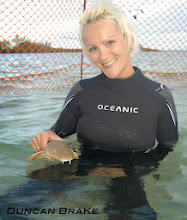
Thank you Amanda Cotton for the amazing image.


My post on Penny's Facebook Page

"I have read as many posts as possible and have tried to gain understanding from both sides, even speaking with a close family friend who was a pro triathlete and now coaches open ocean swimmers. Her response was “Part of the challenge is conquering the elements, not killing off the obstacles.” I know you were not the one who slaughtered the sharks, but unfortunately you are the face associated with the crime. I encourage you to dive with sharks. Take the time to see them on their terms and better understand their place in the system. Without sharks there will be NO OCEANS for your children or grandchildren to swim across. Please know myself, and most others "liked" your page because we had to in order to comment, but there is nothing that I like about the event that occurred."

Tuesday, June 14, 2011

A Very Sharky Wish

This is an article I did for Shark Savers and wanted to share it on here.

Our experience with Lizzie and her family was beyond words and one of the most rewarding things I have ever done. Sharks are lucky to have someone like Lizzie in the world.

Here is the link to the video Duncan Brake and I produced about the Sautter's visit to the Sharklab.


The Make a Wish Foundation was started in 1980 as a means to enrich the lives of children with life threatening illnesses. In January, fifteen year old Lizzie Sautter visited the Bimini Biological Field Station (Sharklab) as part of a very special wish.
Lizzie didn't want to meet a movie star or go to Disney, she wanted to work with marine biologists and get up close to her favorite animals....SHARKS!! I was asked to photograph the events and jumped at the chance.

Lizzie and her family spent 5 days at the field station getting true hands on experience with some amazing animals. Lizzie took shark handling class with Doc Gruber, tagged a near 3m tiger shark and snorkeled with Caribbean reef sharks. She was also fortunate enough to trek through the mangroves of Bimini and see a great hammerhead.

Although it was Lizzie's dream, her family truly embraced the adventure and showed no hesitation in getting their hands dirty...or should I say wet. Mom, dad and sister all swam with the sharks, handled the Bimini boa and even held juvenile lemon sharks, something they all admitted that they never expected to do in their life.


There was a lot of laughter and smiles didn't leave anyone's face for long. The staff and volunteers at the lab experience some pretty remarkable things on a daily basis, but this was something really special. The Sautter family journeyed to Bimini to make a dream come true, but we all considered ourselves to be the lucky ones.Getting to see the smile on Lizzie's face as she tagged her first shark was one of the most rewarding moments of my life. I have been around the world and back sharing sharks with people, but never have I seen a smile like Lizzie's or tears of joy like those from her mom.

The future of sharks is in the hands of people like Lizzie, people who are truly passionate about these animals. It is also exciting to see a young female wanting to get involved, choosing shark science over the endless options she had for her wish. I am sure Lizzie will return to the lab and again bring that special smile and positive energy. Thank you to the Sautter family for letting us be apart of these precious moments.

Wednesday, June 8, 2011

Fiji Sets a Standard for Shark Free Marinas


For a small island nation, Fiji has set a standard for their involvement in the Shark Free Marina Initiative. With 25 marinas signed on, they are still going strong. The Fijian culture respects sharks and the people realize the tourism and environmental value of a live shark. Island nations are limited in their economic ventures, so they protect that which is valuable. At the forefront of the Fijian campaign are Stuart Gow of Matava Eco Resort and Mike Neumann and his team at Beqa Adventure Divers. We interviewed Stuart for a PSA video and he said his involvement was a “ no brainer.” The resort is home to a popular sport fishing charter that also encourage catch and release if catching at all. He said is what a natural progression of the message the resort is already operating by. Stuart was also able to get PADI Project Aware involved in order to cover the cost of purchasing signs for all the marinas.

Mike Neumann and his team at BAD offer the ULTIMATE shark dive and care deeply about the animals they work with everyday. His feeders and dive team have a special connection with the sharks, like nothing I have seen before. Mike did not speak to us on camera, but the actions of his whole crew spoke volumes. Every one of them is truly an ambassador for sharks and for the ocean.

Our PSA will be coming soon, as a busy schedule has kept us away from editing. We were able to bring a new sign for the marina, made possible by the Humane Society of the United Stated. Andrew Cumming, dive operation manager, proudly hung the sign.
Thank you to Mike Neumann and the BAD crew, Stuart Gow and the people of Fiji.
Check out Shark Free for more information and to find out how you can get involved.

Wednesday, June 1, 2011

Caged in: Tiger Beach

The fact that sharks are in serious trouble should not be news to anyone reading this. Shark populations are being devastated globally and they need all the help they can get. We spend a lot of time in the Bahamas enjoying some of the world’s most amazing shark dives and the islands have a special place in my heart. I am not Bahamian, but I spend a lot of my time there and care deeply about the islands, the people and the oceans that surround them. (I am writing this blog sitting at a house on the West End of Grand Bahama Island). The Bahamas are home to a divers range of shark species, with fairly healthy populations. Commercial long lining and finning operation yet have not spoiled the oceans here, but the threat is continuously looming in the distance. PEW, The Bahamas National Trust and the people of the Bahamas are standing up to fight for something they believe in; a live shark is far more valuable than a dead one. Together they are speaking loud and the message is spreading. Strength comes in numbers and the power of passionate people is incredible. I honestly believe the sharks are the Bahamas will be protected.

Most people reading this are shark lovers or at least fans, so encouraging you to shark dive is easy enough. What about your family and friends? Are they scuba divers? Have they ever seen a shark? Do they think you are crazy for getting in the water with man-eating beasts? Do they realize they do not have to be certified to get in the water with sharks?

When it comes to shark diving, everyone has an opinion; even people who have never seen a shark have something to say. It triggers strong emotions- love, hate, terror and ridicule. As someone who has made a career out of shark diving and spent thousands of hours with these animals, I am obviously a huge proponent for it. In my opinion, there is no greater tool in the quest to fight stereotypes about sharks than sticking someone in the water with a shark. Within 5 minutes the Jaws mentality has been replaced with excitement and awe. The majority of the population are not certified divers, so does this mean they do not have the right to see a shark up close? Here is where shark cages come in. A lot of people think they are unnecessary, particularly in places like Tiger Beach, but they serve an unrivaled purpose. They increase the audience that can be reached in the campaign to save sharks. The cage allows people to safely and comfortable watch the animals in a natural environment. They can see the sharks swim, eat and even make eye contact with them. I love seeing how excited people get as everything they thought they knew disappears and they get lost watching these incredible animals.


Just last week I shared a moment in the cage with a guy that had traveled from Canada to see his first shark. I have been emailing with Brian for nearly 3 years and his moment was finally happening. He could hardly hold the regulator in this mouth as a massive lemon cruised by. Brian did not stop smiling the entire trip. He is not a certified diver, just a lover of sharks, who now wants to get certified.

"I had such a wonderful time out on the water and being on the boat. From the excitement of waiting to see the first shark show up, to the thrill of seeing my first ever shark. It is a moment I will never forget. Thanks so much. I fell in love with the Bahamas and the sharks."


I have been leading cage trips for Incredible Adventures for 5 years and I have experienced some of my most memorable moments under water, from within the cage. I will admit that I prefer diving without the cage, especially for filming, but I also have a thousand reasons why the cage has a well-deserved place in the world of shark diving.

People ask me if the sharks get boring or old, and thankfully I have not become jaded. I know I never will because I am so thankful for every moment in the ocean. I get just as excited about a small nurse shark as I do a massive tiger shark. To me, they are the most incredible creations of nature. I think I get even more excited when someone has that first moment, when I can see him or her evolve and the joy that they are overwhelmed with. Knowing I have just helped someone become a shark advocate is extremely rewarding and is something I hope to always be able to do. It is such a rush, one person at a time. It is extremely rewarding and reminds me that there is hope; hope for sharks and hope for our oceans.

I am not saying that everyone should build their own cage and head out to sea, but I am saying that with training or a guide, shark diving is something ANYONE can do and EVERYONE should do!

Wednesday, May 25, 2011

My Mom Kicks Butt


I am very lucky to have a mom that not only supports my lifestyle, but jumps in whenever she can! Here is a newspaper article about her trip to Australia. Mom, you are an amazing woman and I am so proud of you. Thanks for everything!
Mom Goes Down Under!

Thursday, May 19, 2011

Hooked On Sharks

It amazes me that in this day and age people still have an absolute belligerent disregard for the environment. The old excuse, “ we didn’t know,” no longer serves as justification (not that it ever should have). I have written about Bimini before and its history as a big game fishing Mecca. Sadly, what we consider a monster fish has shriveled over the generations, as humans have devastated the oceans. The black and white photos that were seen on the wall of The Complete Angler (Ernest Hemingway’s old haunt for drinking and thinking) and now on the walls of The Bimini Big Game Club, are a thing of the past. Tuna longer than the average man and gorgeous marlin, larger than most sharks are not something our grandchildren will see or know. As pictures fade, so do the memory of what the ocean was.

After our week on the dolphin boat we stayed on the island for a few extra days and decided to rent a boat to do some exploring. Our friends Dony and Michelle joined us as we set off early in the morning, with a day on the water ahead of us. As we cleared the channel and headed south Dony spotted a large black trash bag on the surface. He suggested we grab it because it might be a million dollars from a drug drop. “ That’s how they do it,” he insisted.


Money or not we motored over to pick up the trash that someone felt the need to dump in the ocean. We pulled up and he wrestled with the bag. There was a piece of fishing line attached and we assumed it was stuck on the bottom. Typical boaters trash; bait scraps and used bits of fishing line. Dony struggled a bit and Duncan took a turn on trash removal duty. He quickly realized that the tugging was not from being hooked, but from a shark that was hooked on the end of the line. Throwing the boat into neutral we went into shark tagging mode.

I grabbed gloves and pulled the massive 9ft nurse shark to the surface. Dony and Michelle were in awe and quickly grabbed the cameras. I held the shark steady while Duncan looked for a tool to remove the hook. All we had on board was a small Leatherman, but we knew we had to get the shark off the line. I grabbed the dorsal fin in an attempt to secure the animal next to the boat and then put it in tonic. This healthy male nurse was still in good condition and put up quite a fight, wanting nothing to do with our effort to help him. I switched places with Duncan in order to get a tail rope on the animal and secure it next to the boat. There was no way I could safely hold him for Duncan to remove the hook, without having him secured at both ends. Duncan pulled him to the surface and with one strong roll the hook was free and he was gone. I admit we were pretty happy that we didn’t have to put the animal through anything else in order to free him. Nurse sharks are incredibly strong and without the proper equipment the task was set to be quite a challenge.

We inspected the bag and realized that this was not trash that accidentally attracted a shark, but a make shift shark fishing rig. The heavy-duty trash bag was tied in a knot and the high test fishing line was wrapped around and attached with a fishing knot. The line ran to a weight followed by another length of line and a J hook with a scrap of bait still on it. The equipment was good quality and looked to be brand new. We have encountered block rigs before on a site that is used for shark diving and research. The culprits had used car batteries and cinder blocks tied to wire leaders and large rusted J hooks. This was a different technique, but with the same goal of catching sharks. The sick part is that the “fishermen” might not even come looking for the bags. This leaves trash and an injured or dying animal drifting in the sea until it hooks onto a rock or washes onto shore. We looked around to see if any boats were nearby or watching us, but it was a busy weekend and there were boats everywhere.


We motored along heading towards our dive site and spotted another black bag floating at the surface. Duncan and I told our friends to be prepared because we might find something on the other end that wasn’t as happy of an ending as the last encounter. The bag was near a site that is frequented by Caribbean reef sharks and on a line these sharks stress very easily. Dony grabbed the bag as we brought the boat alongside it. Happily there was nothing but a half eaten piece of bait on the other end. We were all on a natural high from having saved a nurse shark and preventing another shark or large fish from meeting its demise. We also hauled 2 massive bags of trash out of the water. I have to admit it really was a rush to defeat some idiot’s sick mode of weekend entertainment, most likely fueled by alcohol and an audience of idiots, and see an animal return safely to the ocean.

We examined the trash contents and found items that cannot be purchased on the islands. Bimini is small and it is easy to know what you can and cannot get there. This trash was brought over on a boat and that meant the culprits were most likely weekend warriors from Florida. It is one thing to use a rod and reel to catch a large fish, but to damage the environment so recklessly, enrages me. Who knows if they ever intended on finding the bags or if this was just an attempt to rid the oceans of some sharks for fun? It is easy to see that their target species were sharks because of the equipment used. Our excitement turned to anger and frustration. What is wrong with people? Is normal fishing not exciting enough? I am not here to oppose fishing, but I will speak against the devastating method of capture that we pulled from the sea. Again, are we still so ignorant, despite the amount of information we have access to?

We did not see any other bags that day, but we all wondered how many were out there and how many animals were caught and tangled at the moment. We asked around another bag had been spotted, but people assumed it was trash. The Bahamas survive on fishing as part of the economy, but they do not need people coming in and destroying everything they see. Out of season fish, undersized fish and conch and this ridiculous fishing technique. This was just on one busy weekend on one island. In my experience most real fisherman are big conservationists. They want to see the ocean thrive, so that they can share it with their children and grandchildren. They respect the rules, the take and size limits and are often big proponents for catch and release. I am not chastising fishing or fishermen, but I am speaking to the heartless idiots that felt the garbage technique was an acceptable activity. I hope that someone how this gets back to them or someone on the boat. What you did was wrong! Please respect the ocean. Consider your actions and think about what your children would think. Is it really worth it?