When the alarm blared at 6 am I opened one eye feeling like death warmed over. The late arrival into Miami, the early wake up and the jet lag from being across the pond for 3 months had left me with the kind of exhaustion where you are beyond sleep. I asked myself why I scheduled this shoot? The reason: I love the crew and it involved bull sharks! Enough said. Plenty of time to sleep when you are dead, or so they say. Along with bull sharks the shoot was set to include alligators, a critter that I have no experience filming and was keen to get up close with. Yes, another animal with large teeth.
Phil and Kirk arrived to pick us up, camera gear was loaded and off we went in a half awake blur. We drove for an hour before arriving at our home away from home for the next four nights, a USGS houseboat. Yes, a houseboat. Upon arrival we sighted a literal “houseboat, “ television, barbeque and dinning room included-not our boat. Our boat however, was not as bad as it had been described. I was told people might sleep in a tent and that there was no shower. Upon further inspection the tent story was in fact true, but there was a shower. I will admit though, that I did not use it.

I hopped on the boat to give a hand moving our floating home to a dock where all the equipment could be loaded. Standing on the swim step I threw the stern line to Duncan. We secured the boat and as I hopped off Dunk asked me if I had seen the gator? No, I had not. I looked and saw a chubby reptile floating in the sun just behind the boat. Apparently my feet were about a foot away. Nice warning me Dunk! No worries, Willy (we later learned his name) is a bit of a regular and seemed to prefer scraps from the fish cleaning station to my little toes.

Shark gear, gator gear, enough food for an army, toilet paper and our camera stuff made its way to the boat and was temporarily stowed for the journey. Not a lot of space to work with and as soon as seven other people boarded, real estate would become a hot commodity. We bid farewell to Phil and set off on our eight-hour journey to Shark River. The houseboat does not really make way, but instead cruises and we wanted to make sure we could arrive to our destination and anchor with some daylight left.
It is always crucial to know the bathroom situation when you are on a vessel. Our home for the next four days had an incina-toilet. Yes, this toilet burns human waste. Kirk gave us the run down and we learned about the little cup that goes inside, flushing and the burning process. This is a delicate machine and by the morning of day two it was off limits except for emergencies. There are porta potties strategically placed around the study sight and they were visited a couple of times. The other option was finding a place to squat over the edge of the boat. I have no problem peeing off the back of a boat and find it easier than dealing with most heads on boats. As I backed over the edge for the first time all I could think about was my white bottom suspended like the chicken that I have seen at alligator and crocodile feeding shows. I imagined a massive beast cresting the water and snatching me off the back in silence. I decided a higher perch than the swim platform would be a good idea.
In our travel induced exhaustion Duncan and I managed to forget towels, pillows and only grabbed one fleece between us. Our first night we shared the bottom bunk at the back of the boat. There were four bunks; two cots, a tent and the galley table that folded into a bed. The AC was incredible and I woke up freezing, finding Dunk with his jacket over his legs and layers of clothing on that he had not gone to bed with. We shared Monty (my stuffed traveling shark) as a pillow and did not get much sleep. When the rest of the crew arrived we gave up our bunk and were moved to the honeymoon suite-AKA the kitchen table. After dinner we took the table off its stand and removed the stand. The tabletop sat on the two bench seats and voila, bed for two. We used our duffle bag as a pillow this time and managed to use the jacket and blanket to keep us warm. Next to us was a cot and Kirk in his bunk on the other side. Phil took the second cot down the hall, with Adam and Robin in the tent on the back deck. Pat and Mike took the bunks at the back and nine people enjoyed a slumber party on the boat. Going to bathroom at 3:00 am was like trying to navigate a minefield and resulted in a bumped head and stubbed toe. Ahhh, field research!
My previous experience with the Everglades involved an airboat, a guide with about five teeth wearing cutoff denim shorts and two Florida panthers. We were crammed onto the airboat with ten other tourists (I do not consider myself a tourist being that I live in Florida) and braced ourselves for the action. Our guide ripped around corners before stopping to inspect an alligator at the surface. Said gator immediately b lined for the boat just like Pavlov had rung his bell. The alligator played his role accordingly and posed for the, “snap, snap” of cameras. Our attention was drawn away when a woman asked the guide, “ is that a wild cat? ”
Before looking up I was thinking maybe there are feral cats out here –good luck as a gator appetizer. We all looked up and saw the dark feline on top of the dyke that runs through parts of the Everglades. This was no small kitty, but a Florida panther; often believed by many to be an urban legend. On cue as though ready for a National Geographic Serengeti run, the animal set off. I have been told that these animals require seventy square miles and only come together to mate. Knowing this, I was shocked as a second cat climbed up over the bank and moved along the dyke. No way was this happening. The guide radioed back to base and they all laughed. In seventeen years as a guide he had never seen a panther and his ear-to-ear grin showed off his five glorious teeth. When we returned the base we all recounted the tail to the others, so that his story would be validated. Digital cameras also helped, showing images to the doubters.
I was expecting this trip to the Everglades to be slightly different, being that our captain had all his teeth. Anytime you are going to be filming a new animal it is exciting and also a bit nerve wracking. When Duncan and I were doing a scout on the Rainbow River in central Florida we asked our colleague what to do if you encounter a gator? He said, “ you bump them just like a shark if they come around, but they usually don’t bother.” I have done my share of establishing my space to a large shark that is encroaching and do not think twice about it; the thought however, of doing this to a gator feels very uncomfortable. I feel like I have a strong understanding of how sharks move and behave, having spent thousands of hours in the water with them. Alligators are a whole new ball game.
This was set to be a busy trip with hefty ambitions to accomplish in three days. Funding for research can be difficult to secure, so it is necessary to make the most out of opportunities that allow for collaboration. The lab at Florida International University is exceptional at working together to benefit the various members in their different focus areas. The houseboat acted as a base for the researchers to work from with their designated small boats being launched everyday. Robin led the dolphin team. Pat, Mike, Duncan and myself we usually on the film boat. Phil and Adam shared the gator and shark boat because sharks are done during the day with gators being worked with after dark. The footage will be used for an interactive kiosk at the Museum of Discovery in Miami, Florida before national distribution. Very excited to be a part of another education program.
On our first day we ventured out with Robin to look for bottlenose dolphins. I have seen many wild dolphins, but never along the mangroves, using them as tools for foraging. We sighted several groups and Robin took photographs in order to visually identify them. She knows many of the dolphins and knows where they will be hanging out. The rest of the crew arrived later that evening.
Dr. Mike Heithaus was there as host for an interactive video kiosk to be shown at the Museum of Discovery in Miami and eventually throughout the United States. His PhD candidates Phil and Adam were there working on their respective projects and Kirk was our captain, mechanic, engineer, gator catcher, shark wrangle and pretty much anything you need guy.

The bull shark work that is being done includes catching and tagging juveniles. They are found further up Shark River than the larger sharks, using the mangroves as a refuge. Sharks are cannibalistic and juveniles are not safe from adults, even those genetically related. The mangroves provide a nursery until they are large enough o survive in the open ocean. Bull sharks through the process of osmoregulation can tolerate brackish and fresh water. This process allows them to maintain an internal water concentration regardless of their environmental conditions. They have been found hundreds of miles up freshwater rivers and have gained more of a monster reputation for their presence in unexpected bodies of water.


The goal was to film a juvenile being released, but this was far easier said than done. Mangroves release tannic acid, which gives the water an iron yellowy brown color. The soft silt bottom is easily disturbed and the places with shallow clear water are often in the deep shade of the mangroves. One slight step to get the shark in the right spot and a cloud would rise. We would move as quickly as possible to avoid being overcome by the blob; more often than not we were defeated, sent back to our vessel in search of a new backdrop. We maneuvered, held sticks, stood on one leg, cursed a bit and went up to our armpits in dark water, but managed to get a few shots. That is one of the reasons I love filming nature though, there are always challenges that force you to get creative. It is nothing short of an adventure each time.

Snook behave better than bull sharks. I learned this as we joined
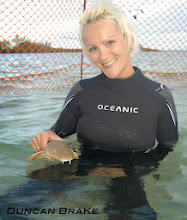
Dr. Jen Rehage and her crew for some electro fishing up river. Electro fishing allows the team to capture many fish quickly and efficiently without having to hook them. The stunned fish are held in a large tank on the boat. They are measured and tagged (PIT tags that are inserted under the skin) before being released. We needed to get a release shot of a snook and this meant that I needed to go for a swim. Everyone staying high and dry had ideas about where I should film, but I wanted a place that I could stand and see bottom. The fish team knew a rocky spot that they thought would be perfect. I slipped on my Riffe cryptic blue camo wetsuit (not exactly camouflage in this environment) and lowered myself into the water. Mike asked if I want some white sharks in there with me. “ At least I would know what I am working with. I am good with great whites.” It’s the water moccasins that I was worried about, not gators or bull sharks.

To film the snook I needed someone in the water to do a release. Jen hoped in and received a fish from her crew. She is floated in open water, well not actually open, but she was not pinned against the mangroves like I was. We worked together to get some beautiful shots of our cooperative snook and I began to relax. Jen said they swim their all the time and she assumes her students will let her know if a gator is headed her way. I passed the camera back on the boat and took a mini swim. The water was lovely and I actually wanted to stay in a while. I was shocked at my new found sense of comfort, but I guess it all what you are use to.

Filming alligators was a bit easier than the bull sharks, although shooting at night always poses a series of challenges. The first being that it is dark out and in the Everglades there is absolutely no light pollution. Working on a white boat where people are shinning massive spotlights and all wearing headlamps, aside from causing temporary blindness, can create harsh hot spots and shadows. The two teams split up as the sun went down and headed down our respective routes with a rendezvous point at the end. Adam briefed us on how the events would play out and defined everyone’s roles. We wasted no time in spotting a pair of red eyes floating just above the surface. At that point I am contemplating horror stories about young adventurers being picked off one by one by an overgrown reptile lurking in the mangroves.
As we slowly approached our target everyone was quiet and Kirk sat poised on the bow ready to pounce like a cat. Snatching an alligator is no easy task, especially in the dark among snarled mangrove roots. In one quick move the snare was around the gator and the notorious death roll began. A second snare was placed around the gator’s mouth. Kirk and Adam lift the alligator into the boat and quickly secure the mouth shut with tape. Now this may sound a bit brutal, but it is for the protection of the animal as well as the crew. Of course this is not the most comfortable experience for the animal, but the knowledge that is gained will help alligators and other species that call the Everglades home, to survive and thrive. I asked if it was a male or a female and Kirk grinned, stating that Adam would let me figure that out later. Oh boy!

Being the comedian that I am, I decided to name our little gator Einstein because Adam said they do not usually catch the really savvy animals. When I finished getting my shots I took a moment to really look at Einstein. Gators, like sharks, get a bad rap. The detail in its skin is remarkable; each scoot placed perfectly. The skin is soft to touch and the belly is a beautiful cream color. The most incredible part was the eye; not the cold space I expected, but gentle, almost soft. I studied Einstein for a long time, figuring this might be the only chance I get to be this close to a wild alligator. Powerful remnants of a past existence on the planet, they really are an amazing feat of evolutionary engineering.

Back on the houseboat each gator was worked up just like a shark. They are measured, weighed, DNA and blood samples are taken and the sex is determined. Unlike sharks, there are no obvious external sex organs, so one must do some internal investigation. When the time arrived to determine whether Einstein was a lady or not, Adam rolled up his sleeve and asked if I was ready? Sure. He lifted the rear end of the animal and showed me the slit where the cloaca was. He instructed me to insert two fingers and to tell him what sex I think it is. Not something I get to do everyday, so in the name of science I went for it. The area was smooth, so I stated that it is a female. Winner! Adam was so excited that I expected a gold star for my deduction. Einstein is a little lady.
The next gator is maneuvered for it’s workup and I am called upon once again to determine the sex. I insisted that Duncan might want to have a go, as it is something everyone should experience once. I got the, “ no way in Hell,” look from Dunk and role my sleeve up. He has just gotten back from the other boat making a last check for gators nearby our base and was not expecting to walk in on his fiancé with her hand up a gator. I reached in this time and my fingers met an obstruction. As I removed my fingers the penis followed and the gator proceeded to pee on my hand. Excellent. We didn’t even have dinner, Hell I didn’t even know his name. I will not describe the comments and jokes that followed, but allow you to use your imagination. Needless to say there was no shortage and they continued for the rest of the trip.
The last day we set off early to make our way back to port. A leisurely cruise, as the gorgeous Everglades slipped away and the ocean landscape took over. Back at the port I moved to a place on the dock where four or five people had gathered and were pointing. There were four manatees in the marina including a very small calf, nuzzling next to its mother. As I watch the mother and calf, a large manatee surfaced right below me. That walrus nose peaked into the air and the massive scars on its back shone white. Such a gentle creature and a beautiful moment tainted with the ever-present reminder of human destruction.
Burning poop, alligator cloacae, dark and scary water, electrocuted fish and a giant slumber party, pretty much sums up this adventure and I can’t wait to do it again.