As you have probably guessed from my previous entry, Monkey Mia is tucked away in a pretty remote part of the world. Being part of the Shark Bay World Heritage Site, this area has been minimally impacted by human intrusion. Animals are protected, the natural resources are valued and it remains pristine. The sea grass beds of Shark Bay are the heart of a very complex ecosystem that has an incredible amount of diversity. The human condition has not intoxicated the area, so it is possible to study these animals in a place that is still raw and wild.
Monkey Mia has put itself on the map for the beach dolphins that come in each morning to feed. This activity has been drawing tourists from around the world for over 30 years. In the beginning people could buy a small bucket of fish and feed the dolphins as they liked. Unfortunately this caused the female beach dolphins to neglect their calves and spend most of their time begging for food. Nicky, named for the “ nick” in her dorsal fin, remains the biggest beggar and has lost 7 of her 8 calves. She was also, on average, biting 6 people a day when the feeds were not regulated. Today the dolphin feeds are guided and monitored by the Department of Conservation (DEC) rangers. They ensure a safe interaction between human and animal, as well as monitoring the behaviors of the dolphins. I prefer sharks to dolphins any day, but I must admit having a wild dolphin cruise through to say hello when you walk the beach at 11 pm is pretty incredible.

Our first crew, myself included, was there to film some of the research being done as part of curriculum based series of videos for middle and high school students. This unique ecosystem has catalyzed a dynamic range of studies from sea snakes to tiger sharks. All the organisms within the system affect one another directly and indirectly. It is possible to specify how and what is interacting within the system, with the possibilities for research being endless. Mike Heithaus is the host for the videos and his energy and passion are contagious. There is never a dull moment and the science comes alive. Pat Greene, who first worked with Mike as an assistant in Shark Bay and then filming the Critter Cam series, was there as the topside shooter and producer. Many scientists and researchers chose to do so because they are not exactly social butterflies. Mike, however, has an innate ability to connect the research to the average person and get them interested and even excited. This connection is crucial in spreading awareness about the current conditions of our oceans. I have been fortunate to work with Mike on a few occasions and he never fails to make the hard work pale in comparison to the adventure.
The video work included the deployment of spot tags on large tiger sharks, capturing and tagging turtles and rays, as well as deploying cameras to assess fish predation in the sea grass beds. The weather was not on our side, so every moment was precious. The long days started at 4:30 for me, usually joined by Derek in the caravan. Took me nearly 2 weeks to sleep past 5 am. It gave me the chance to enjoy the beach dolphins and do some yoga before the workday began. At this point is has been 100 degrees or higher every day. By 10 am the A/C in the main caravan is overrun and the sweat fest begins. My first sleeping area was a bunk in an annex built next to a caravan with only a small fan for airflow. Ah field work. No worries, life is not bad when you are in Monkey Mia and better the heat than snow and freezing temps.
The main caravan, which also served as a bedroom the first time I came to Shark Bay, is the lounge, office, supply shed, kitchen and dinning area. It is older than any person working and living there and has strategically placed duct tape and zip ties holding it together. The old fridge is now dry storage and items are squirreled away in the bathroom (now a closet) and in every cupboard and space possible. The gas stove is temperamental with the flames either on full or off, which makes cooking eggs an adventure. The oven only has one row of flames, so it is necessary to rotate whatever is cooking every 5 minutes or so. Despite this I managed to make a very yummy vegan chocolate cake, peanut butter cookies, naan bread and dinner rolls. The air conditioner was overpowered by about 10 am each morning as we saw temperatures over 100 almost everyday. At this point you just accept that no matter what you are doing inside or out there will be sweat. It is one of those places that being on the water is where you want to be.
The field station is located on the backside of the resort in the caravan area. The restrooms are part of the resort, so having to pee at 3 am is really a mission. There is only one set that has freshwater with the others having bore (salt & fresh mix) water, a pleasant surprise when you brush your teeth the first time. The beds are stashed amongst different caravans, so where you sleep and with whom may change during the course of a visit. As I mentioned above, my first bed was a bunk in an annex with no air conditioning and a fan that worked when it felt like it. I know this seems like a lot of issues and maybe complaints, but I want to highlight how none if this matters when you step outside and see the paradise that is at your doorstep. As a field researcher life is not glamorous, but you experience things that no amount of money could buy.
The fleet of boats has changed since my first trip in 2006. Sadly the high salinity in Shark Bay is constantly eating boats and motors, so they do not last very long. Suckerfish has been replaced by Cuvier (tiger shark) and Hellafish has been replaced by Caretta (green turtle). The customized Blowfish II, designed for work in Shark Bay, has replaced Blowfish. The high salinity within the bay reeks havoc on boats, trailers and anything else that spends anytime in it or near it. We helped Derek change the throttle cables on Blowfish (actually pretty interesting) and then she was ready for her maiden voyage of the season. I was pretty excited to take her for a test run, as Derek had to be on the other boat for some filming. It has been a while since I have been able to drive a boat and it was awesome!! She really is lovely to drive, with a lot of power and excellent handling. This was a nice change from Caretta, which had been our vessel while we waited for parts. Caretta gave up on us twice and we had to get towed to shore.

The priority for our time here is getting satellite tags on large tiger sharks. It is known that they leave the bay in the winter, but numbers are dropping each year. The tags will hopefully tell us where they are going and if they are being fished out. This highlights the importance of not only protecting an area, but a species, as they are migratory and most often leave the sanctuaries or protected areas. Proving this with data collected from satellites strengthens the movement to expand marine protected areas to a much larger scale globally.
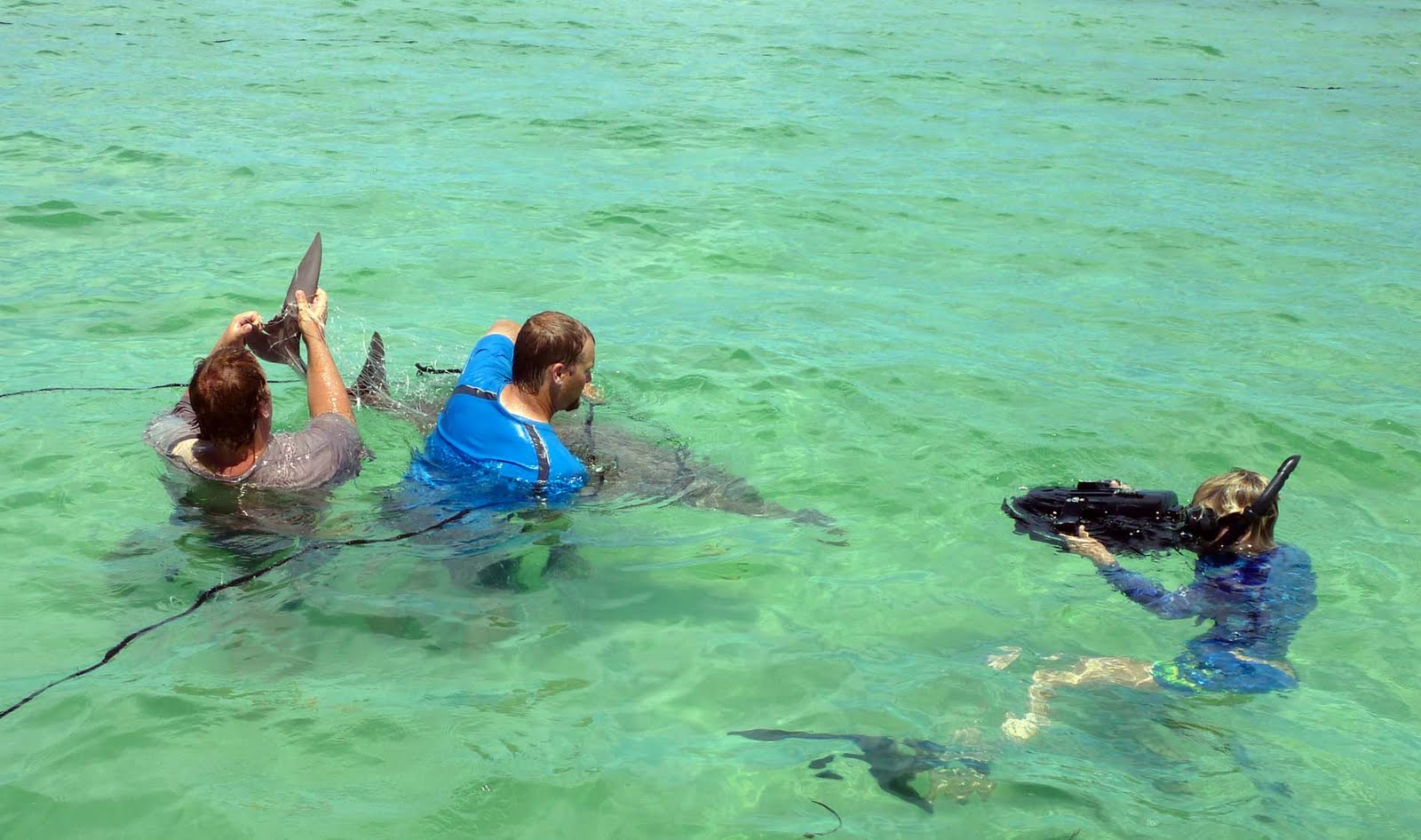
The sharks are caught using the drum line method. This setup has a baited hook attached to a set of floats with a longer length of line attached to an anchor that sits on the bottom. This allows the shark to swim freely in a circle and not tangle itself, reducing the stress on the animal. The lines soak for a short period of time and then it’s SHARK TIME. Running the lines is very exciting because you never know what you are going to get. Once we have a shark on the line it is important to handle the animal quickly and efficiently to reduce stress. The animal is brought beside the boat, so that it can continue to swim and breathe. The shark’s length is measured, a DNA sample is taken by snipping a small piece of the dorsal fin, a tag is inserted and blood is taken. The hook is removed and the animal is released.

We also busy catching turtles and rays. The method of capture is slightly different, but the data collected is the same. Rays are caught in the shallows using a weighted net that is released from the boat in a massive circle. This reduces the area the animal can move and people jump in with smaller dip nets to secure it.

Most of the work is done in the water if possible, again to reduce the stress on the animal.

In order to catch the turtles someone must dive off the bow of the boat and catch them Yes, that is what I said. A person rides the bow of the boat as it cruises along and looks for turtles. When one is spotted the jumper directs the boat driver, as the wear the turtle is moving. This becomes an exciting ride with the boat doing donuts, speeding up and slowing down. I love being the driver when someone is turtling. It is challenging, but so much fun. An excuse to drive crazy! Once the turtle slows a bit the person dives in and grabs them behind the head and swims them to the surface. This is a lot easier said than done. It takes a great deal of practice and there are lots of dirt darts into the sand and belly flops. The turtle is brought on the boat and the data is collected before releasing them.

Long days, no Internet or phone, 100 degree temperatures with no air conditioning would be enough to deter most of the population off, no matter how beautiful the location is. It does take a special type of person to not only tolerate less than ideal conditions, but to make it their life for weeks or months on end. They may enjoy a day or two, but when it gets to the down and dirty they crumble. For me personally, I have a long list of reasons that make any challenges or discomfort disappear. 5 am setting of shark lines is not a problem when you know that within a few hours you are going to be handling a 3m tiger shark. Watching the sunrise as dolphins ride the bow of your boat, watching dugongs cruise through the shallows, catching 300lb loggerhead turtles and seeing sea snakes floating at the surface while they digest a fish; yes these are the moments that make it a life changing experience.
Hiking to the top of a red sand cliff and then surfing down to crystal clear water, spotting a manta ray effortlessly swimming by, catching a tagging a species of ray or shark that you have never seen, knowing that the data you collect is helping not on the species, but the oceans in general. Seeing the sky painted the most brilliant reds and purples as you sip a ice cold beer, having a dolphin swim to the boat and beg for food, stars filling the night sky because there is no light pollution and sharing all these moments with a small group of incredible people. As I am writing this I am vividly remembering the smells and the sites of this place. The way the ocean air feels against your skin as you are breaking through the waves. The way a shark’s skin feels and the color of their eyes. The endless postcard moments are yours forever. This is why I don’t care about air conditioning, an uncomfortable mattress or salty showers. I guess I am lucky because if everyone could do it the opportunity would not be as unique.