Showing posts with label Bimini. Show all posts

Wednesday, April 8, 2015

Saving Sharks the Other 51 Weeks a Year


Sharks Deserve More Than a Week's Worth of Attention Each Year

Happy 2015.... well April 2015. My personal blog has been severely neglected, as I have been spending a lot of time swimming with sharks and working on education projects for Sharks4Kids. If you have not checked out our shark education non-profit PLEASE DO! You can also find us on social media facebook/sharks4kids  twitter: @sharks4kids and instagram: @sharkeducation.


I just got back from the Florida Keys and after spotting a few shark trinkets in a souvenirs shop, I started looking over some articles I had written about things people can do to help sharks. This article was featured in the August issue of Coastal Angler, but I wanted to share it here as well. We can all do something; think globally, act locally!


Each year millions of viewers around the world tune into Discovery Channel for an entire week of programming dedicated to sharks. Companies come up with shark themed advertisements like comparing a razor to a great hammerhead or daring customers to be “bold,” by diving with sharks or eating a new flavor of chip. It is great to see so much attention focused on these amazing animals, but in reality these conversations should be happening year round. Whether you love them or hate them, sharks play a critical role in the health of our oceans. Case in point, we need sharks.


Things to Think About Year Round:

Most sharks are top predators in the food chain and keep the ocean ecosystems balanced. They feed on injured and sick animals, helping to maintain a sustainable level in populations of animals below them in the food chain. I personally have been diving in parts of Indonesia where the sharks have been fished out and there are very few fish left and the coral reefs are dying.

Sharks are not man-eating monsters. On average five people die from shark attacks
each year, while humans kill approximately 100 million sharks each year. They are targeted primarily for their fins, used to make shark fin soup, but also for their meat and as bycatch (non-targeted species). Products are also made from their cartilage and the oil from their livers called squalene. 


Shark finning is when the fins of a shark are cut off while the animal is still alive and the mutilated body is thrown back in the water to die. In 2014, New Zealand became the last non-Asian developed country to ban shark finning and it was banned in the United States in the year 2000. 


Most of us are familiar with mercury when it comes to eating seafood. Mercury is a metal that bioaccumulates in ocean ecosystems. Animals cannot get rid of it, so the further up the food chain you go the higher the concentration of mercury. A STUDY done by University of Miami’s RSMAS also found high concentrations of neurotoxins ( BMMA) in shark fins. These neurotoxins are linked to neurodegenerative diseases including Alzheimer’s and Lou Gehrig Disease( ALS). Even smaller sharks like spiny dogfish, often used in fish and chips, have high mercury levels and can cause serious health risks if consumed.

Sharks can get cancer, so taking pills derived from shark parts will not prevent cancer. Even if sharks were immune to cancer, the pills would still not have an impact. I like shark biologist David Shiffman’s analogy, "Even if they didn't get cancer, eating shark products won't cure cancer any more than me eating Michael Jordan would make me better at basketball."

Sharks do not belong in jars or as souvenirs on our walls. If you have even been to a souvenir shop in South Florida than you have probably seen shark jaws or shark fetuses in jars for sale. The shark fetuses are creepy and completely unnecessary.

Shark diving is a multi-billion dollar industry globally and has shown a positive impact on shark protection. The best way to fight misconceptions about sharks is to see them in the wild and on their terms. In the Bahamas alone, there are multiple shark diving destinations including Bimini, Nassau, Freeport and Cat Island.

Ways to Make Every Week Shark Week

1.    Don’t be afraid to ask what it is you are eating and choose sustainable seafood. Oceans around the world are heavily overfished, so chose species of fish that are fast growing and breed often. The Monterey Bay Aquarium offers a Safe Seafood guide that can fit in your wallet. Also, don’t be afraid to ask what exactly the “catch of day” is? A STUDY released by Oceana in 2012 found, “31% of seafood mislabeled in the Miami/Fort Lauderdale-area during a survey conducted in 2011-2012. Fraud was detected in half of the 14 different types of fish collected, with snappers and white tuna being the most frequently mislabeled.”

2.    Do not buy shark products. This includes shark cartilage pills, shark souvenirs and products containing shark liver oil (squalene). This oil is found not only in pills, but also lotions and make-ups. 
 
3.    Go see sharks. If you are a scuba diver chances are you have encountered a shark, but if not you should definitely book a trip.If you are not a diver there are lots of great snorkeling options around the world and seeing sharks might be a reason to get your scuba certification!


4.   Learn the facts. ( Factual AND fun)

-There are over 500 species of sharks and they are found in every ocean around the world.
-Sharks are slow growing, mature late and give birth to very few offspring, making them extremely vulnerable to overfishing.
-Greenland sharks are believed to live up to 100 years.
-Lemon sharks can bite their own tails.
-Tiger Sharks can invert their stomachs.
-A frilled shark can be pregnant for up to 3.5 years.
-Goblin sharks have pink skin.
-Megalodon was a real shark, but is now EXTINCT.
-The term “Elasmobranch” is a collective name for sharks, skates and rays. Elasmobranchs have a skeleton made of cartilage, no swim bladders, five to seven pairs of gills and skin made up of small dermal denticles.
-  A STUDY done by IUCN (International Union for the Conservation of Nature) reported 25 % of the world’s sharks and rays are threatened with extinction. 

5. Support Organizations working to Save Sharks

 There are lots of great organizations working to better understand these animals through science and research, as well as organizations working to put better legislation in place for protection of sharks. Some of my favorites include

Sharks4Kids-Shark Education for students and teachers
Shark Defenders-Working towards the implementation of shark sanctuaries around the world
Bimini Biological Field Station- Shark Science and Research 
Save Our Seas: Supporting Shark Science & Research, Shark Conservation & Education
Guy Harvey Research Institute-Shark Science and Education
Shark Advocates- Shark protection legislation and advocacy
The Shark Trust -Shark Advocacy and Education, supporting Shark Science.

 RJ Dunlap Marine Conservation- Marine Science & Research, Shark Science & Conservation

I am thrilled that sharks at least get one week of intense attention, but in reality they deserve a lot more.

Sunday, October 5, 2014

Shark Sunday: Caribbean Reef Shark Encounter


There is a popular dive site here in Bimini frequented by not only the Bimini Biological Field Station ( Sharklab) for research and education, but also by local dive and eco tour operators. My first visit to the site was in 2004 while working on a research vessel that was visiting Bimini and I have been there dozens of times since; I am happy to report that it never gets old and you never know what you will see.

The usual stars are Caribbean reef sharks with anywhere from 2 to 20 making an appearance. Like any site frequented regularly, you start to recognize specific animals and I am always happy when old regulars show up.


Although the Bahamas is a shark sanctuary, we have seen people and fishing gear on this site with sharks as their targeted species.

The Bahamas Shark Sanctuary Approximately 243,244 square miles
Shark Fishing Gear Left Near Dive Site


Caribbean Reef Shark with a Hook Scar on the Mouth


It had been about a month since Duncan and I visited the site, so with a beautiful day before us we headed out. As soon as we anchored up a single shark finned at the surface. We threw a few pieces of bait in and very quickly we had 4 sharks. We geared up, got the cameras ready and slipped in.

Happiness! Who Needs Diamonds?! Sharks are a Girl's Best Friend


The water was crystal clear and the sunlight danced in ripples on the gray skin of the sharks; I absolutely love days like this. We spent over an hour in the water diving down and holding our breath, being as much part of their world as we could for a brief amount of time. The ocean is quiet place and I love lying on the bottom and just watching. I love sharks, if you hadn’t already guessed, but watching them never ceases to amaze me. Lost in the moment, my body reminded me that I am a land animal and must return to the surface.

Duncan Filming Caribbean Reef Sharks 


Freediving Shark Selfie

Throughout the Bahamas Caribbean sharks dives and snorkels draw divers, film crews and shark aficionados from around the world. These sharks are also responsible for educating thousands of people and changing fear into fascination and respect. Five minutes is all it takes to create a new perception and shark eco-tourism throughout the Bahamas has not only been good for the economy, but good for the sharks that swim around these islands.

We ended our dive and got back on the boat. I threw in some of the last scraps of bait and chatted with the sharks, as I always do. Duncan giggled, like he always does, amused by running commentary. I absolutely love being around these remarkable creatures.

Shark Geeks! Loving The Gorgeous Day!


I am a huge proponent of getting in the water and having your own shark experience, so if you find yourself in the Bahamas or somewhere offering a shark encounter, I encourage you to dive in! If you are in Bimini check out the Sharklab's Research Experience , Bimini Sands for shark snorkels or the Bimini Scuba Center for scuba diving trips.

Friday, August 22, 2014

Shark Tours and Eagle Rays: Another Week in Paradise


In my previous post I highlighted the fact that every week is Shark Week in Bimini and this one has been no exception.  One of our favorite things to do is share the Sharklab (Bimini Biological Field Station)with friends who visit. Duncan and I are both alumni and still collaborate on projects as often as we can. Dr. Samuel Gruber (Doc) started the Sharklab in 1990 as a base for his lemon shark research. Since its inception, the lab has been at the forefront of shark science and continues to draw scientists, conservationists, students and film crews from around the world. They are now also offering an exciting opportunity to the public with their 5-day Research Experience trips.  For 5 days you get the chance to experience life at the lab and learn all about they work they are doing. This includes a snorkel with Caribbean reef sharks and a trip to a juvenile lemon shark refuge (nursery) in the mangroves. If you have any curiosity about sharks, I cannot recommend this opportunity enough. Bimini and the Sharklab are truly amazing places to visit.


Okay, back to our Shark Week. We had friends in town and they wanted their parents to see the lab, so off we went. Both of their mothers were a bit nervous about the sharks and not sure if they even wanted to touch them. We explained that the pens where the lab holds a few baby sharks are in shallow water during low tide and that they could watch from the outside. I secretly hoped though, that they wouldn’t just want to watch. The previous day they had seen a stingray while floating on rafts off the beach and had both held their arms and legs out of the water until it swam away. “ What about Steve Irwin,” they asked? Stingrays cannot lunge or throw their barb, a common misconception. Most accidents happen because someone steps directly on the barb. After a few minutes of chatting they both agreed it was time to put touching a baby shark on their Bucket List, well maybe.
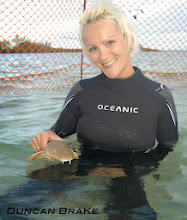
As we waded out we explained the lab, how it started and the research they are currently doing. The pens are used to hold a few sharks for 30 days or less. The sharks are used in some research, but mostly for educational tours and teaching new volunteers. The sharks are released in the exact spot they are captured. As we neared the pen I could see a southern stingray in the mix, perfect. The stingray was in the pen for a visiting marine biology course and had had its barb removed. This is a great chance to see yet another misunderstood animal up close, so I was glad to see it there. Duncan and I had everyone stand around the edge of the pen while I got a nurse shark. Most people have not seen a baby or juvenile shark, so they are quite surprised to see how small they can actually be. I talked about the anatomy of the shark; its behavior and everyone decided they wanted to feel the shark’s skin. Nurse sharks are very cute when they are small, so they are great ambassadors for sharks and changing peoples’ perceptions.

Talking to the group about nurse sharks 


Showing the nurse shark belly ( a few spots) and the claspers ( male sex organs)


When I finished speaking about nurse sharks we asked if anyone wanted to hold the shark.  I am happy to report that despite the initial hesitation, everyone held the little shark and was thrilled to learn so much about them. We moved onto the lemon shark and as Duncan was talking about them, the stingray decided it needed some attention and swam right onto Judy’s toes. She was bit startled, but no longer fearful. Curiosity and facts had replaced fear. YES! Duncan showed the features of the lemon shark and we chatted about the mangrove nurseries here in Bimini and the fact that juvenile lemon sharks are social and have buddies. This is one of my favorite facts, that and the umbilical scar (“belly button”), to share with people. Words like nursery, baby and belly button definitely change the conversation when referring to sharks. We finished the tour with a group photo and continued to answer questions. Everyone was really excited and the conversation continued later that evening at dinner. My heart melted when Sandy said they had jumped in to swim with dolphins that afternoon, something she would have been too afraid to do before we taught them about the sharks. I have watched those little sharks catalyze a thought change regarding sharks in a lot of people and if you are ever in Bimini you definitely need to visit the lab! If you are not a fan of sharks, you might just become one after the visit!


While we were at the lab Rachel, TJ and Jack (all lab managers) cruise over with a special surprise; a baby eagle ray. We see tons of eagle rays both solo and in schools, but I have never seen one this small. Our friends got to see the little guy and learned a bit more about another one of Bimini’s amazing creatures. The lab put the eagle ray in a large holding pen and had someone keep an eye on it. The visiting course students were able to snorkel with it, again a rare treat. One of the best things about Bimini is that you never know what you are going to see on or in the water! After our friends left we spent a little time with the eagle ray. They are the most graceful animals in the water, gliding effortlessly. This one had a wingspan of about 12-16 inches. This is not much larger than when they are born, so this one was definitely less than a year old.

Juvenile spotted eagle ray

Our Sharks4Kids spotted eagle ray poster
We then headed out to film some upside down jellyfish (cassiopeia) , not the most exciting thing, but still a cool animal. We finished filming and saw a few juvenile lemon and nurse sharks cruising at the edge of the mangroves before heading across the lagoon for home. We stopped for a minute at the edge of a mangrove island to jump in the water and cool off. I noticed a lemon shark behind the boat. I jumped in to have a look and saw two. They appeared to be 1 to 1.5 meters in length and we knew Rob, a PhD student doing his research at the lab, was looking for that size. We radioed him and started to throw some bait in the water to keep the now 5 sharks around. Rob arrived with his crew and put their rods in the water. Within a few minutes they had a shark and got it in the holding tub on the boat. Juveniles are placed a in a large tub with a bilge pump to keep the water moving and the water is replace often so they have a sufficient amount of oxygen.


Lorna, the assistant lab manager, scanned the shark with a PIT tag reader and it beeped. The PIT (Passive Integrated Transponder) tags are injected into every lemon shark caught by the lab and give valuable data about the life history of these animals. They are similar to a microchip your cat or dog may have and give each shark an ID. This is a simple method to gather data about an animal over time. Rob decided the shark was not large enough for what he needed and released it. We decided to call it a day and headed in.
PIT Tags Image: Destron Fearing

I love Bimini and I love days like these.

Wednesday, August 13, 2014

Shark Week: Bimini Shark Tales


It’s Shark Week, which means people around the world are thinking about, talking about and watching shows featuring, you guessed it; sharks. Although Shark Week is notorious for sensationalism and “mockumentaries,” there arises a great opportunity to have a real conversation about sharks, shark conservation and the problems they are facing around the world. Here in Bimini pretty much every week is Shark Week. This tiny island chain in the northern Bahamas is home to the first Shark Free Marina in the world and is part of the Bahamas Shark Sanctuary. Some of the best shark research in the world has also happened right here at the Bimini Biological Field Station(Sharklab). Despite being small in size, Bimini is truly a world force in shark science and shark conservation.
My husband and I are both Sharklab alumni and have absolutely fallen in love with the island. We spend as much time here as possible and there is rarely a day we do not see sharks. Different species are here seasonally, along with a few regulars we see year round. We spend a lot of our time filming and photographing these amazing animals and occasionally get to assist the lab with research projects.  People travel from around the world to see these sharks, study them and dive with them and for us; we travel to our “backyard.”

Shark Selfie with a Bull Shark Off South Bimini!
My blog has been heavily neglected because all of my time has been devoted to our newest endeavor, Sharks4Kids. We created this non-profit as a means of spreading shark education to kids around the world through curriculum, activities, videos and classroom visits. Please check out the page and feel free to message me for more information. Okay, now back to the sharks.  Over the next few months I will be sharing information, images and videos highlight the sharks we see here in Bimini. I will include our adventures, facts about these animals and notes on shark research and conservation happening on the island. Sharks that will be featured include great hammerheads, nurse, lemons, bulls, Caribbean reef, smalltooth sawfish and the elusive pitbull shark!

The Rare and Elusive PITBULLSHARK!

I hope you enjoy these shark tales each week of the year, because sharks deserve more than a week of global attention! Please feel free to email me any questions you have!  You can also find me on twitter and Instagram @BiminiSharkGirl
FINS UP
Living the Shark Life

Tuesday, August 6, 2013

Bimini Shark Week with Deano Cook


In my life every week is Shark Week, but there are definitely weeks more intense than others. A recent visit from photographer, painter, tattoo artist and good friend Deano Cook was one of those weeks. I met Deano in 2007 when I saw him tattooing marine artist Wyland at a convention. As a lover of sharks and tattoos, I knew right then and there I had to have a piece of his art on my body. It took six years of busy dive schedules and missed attempts, but we finally made it happen when he came to visit us in Bimini.

Bimini is one of my favorite places on the planet and I absolutely love sharing my home with people, especially those that have a real passion for the ocean. We wasted no time getting in the water and headed out for a Caribbean reef shark dive. The site here is pretty shallow, which is nice change from most of the deeper shark dive sites throughout the Bahamas. We had about eight reef sharks cruise through and two little blacknose sharks. They are considerably smaller than the reefs, but have no problem getting right in the mix. We spent an hour with these beauties before heading due south in search of stingrays.

IMAGE: DEANO COOK


Honeymoon Harbour is Bimini’s smaller and less commercialized version of Grand Cayman’s Stingray City. We anchored just off shore and it was only a matter of minutes before the troops came flying in. For years, visitors have interacted with a large population of Southern stingrays and the occasional lemon, blacktip or nurse shark at this location and it is a favorite spot for most visitors. On our last few visits a very precocious nurse shark has made an appearance and seems to have no problem begging for a snack amongst the rays. Animals are really clever and I love seeing large species interact with each other. I know nurse sharks do not garner a lot of excitement from diehard shark enthusiasts, but I love them.


Another regular, a ray we affectionately call, “ The Blanket,” showed up to welcome Deano to the island. This female Southern stingray is probably five feet across and has no etiquette when it comes to interacting with people. She is large and in charge, sitting on your lap, knocking you over and completely smothering your camera. She is definitely the matriarch of the group and quite assertively lets everyone know this. We spend a lot of time with these animals and it is incredible to see their personalities become more defined the more time you share with them. Yes, they are all the same species, but they are definitely not cut from the same mold. I always get the giggles at this site because it is impossible to not laugh when a stingray is tickling your toes.


We returned to the reef sharks the following day and got some great shots with our new Oceanic and Lavacore gear. Our dive was cut short by some nasty squalls moving in. They come is fast and hard during the summer months in Bimini and can quickly knock the visibility to zero. They are so pronounced and confined however, you can usually avoid the brunt of them. We headed out and actually lost power in our port engine, which kicked us around hard on a large swell and sent Deano flying across the boat. We turned to head south towards the medical clinic on Cat Cay. What should have been a fifteen-minute ride, took over an hour with the wind and swells. We arrived and Deano was able to move around, but had definitely sustained an injury to the ribs. We made the slow cruise back to South Bimini and headed to the clinic because the doctor was not available on Cat Cay. The doctor told him he should get x-rayed in Nassau, but Deano was not going to miss out on diving, sharks and tattooing.

We took it easy the next day, but Deano did not want to miss out on opportunities, so we made it work and headed to the Sharklab. We spent time in the pens with some juvenile lemon and nurse sharks and Deano was able to get some images as well as hold a few of the little guys. It really is a special experience and I never get tired of hanging out with those cute little babies. Sharing miniature versions of the ocean’s might predators is a powerful tool for education. Deano is a shark lover, but for many people seeing how “cute” a shark can be really changes their perception about these animals.


The mangroves were next on our list because they are the heart and soul of Bimini and a place everyone should take the time to visit. It may not seem exciting, but the amount of life above and below the surface is remarkable. We showed him the mega resort on the north island and explained the damage that has been done and the impending threats that are looming. Bimini is not a bustling metropolis, nor should it ever be, but the quiet of the mangroves really takes you away from the hustle and bustle of everyday life. I am not sure how excited Deano was about the mangroves to start, but within minutes he was raving about how incredible they were.


As if on cue, a juvenile lemon shark swam out in front of our boat and cruised through the gin clear water just ahead of us. We know the sharks use the mangroves as a nursery for the first 3-4 years of their life, but it is always exciting to spot one. It was really awesome to see how excited Deano got as well. A tree-lined channel is not where you expect to find baby sharks and these encounters are always surreal. We continued onward spotting schools of snapper, small conch and birds. We paused for pictures and to talk about this incredibly diverse forest and why it is vital for Bimini and the oceans of our planet. These nurseries are critical for healthy populations of not only sharks, but snapper, conch and lobster; all major components of the Bahamian economy.

We hopped in for a snorkel in Bonefish Hole and found schools of silversides dancing in the sunlight, giant stingrays buried in the sand along the edge of the mangroves, hundreds of snapper, tiny butterfly fish and sergeant majors peeking out from behind the roots and dozens of small lobster taking refuge under mangrove root ledges. This forest is literally overflowing with life. I watched a crab eating a snail, while delicately balanced on a single branch. The weather was rough at the edge of the channel, so we didn’t spot any turtles for Deano, who was desperately hoping to catch a glimpse of the juvenile greens that hang around, but regardless the day was amazing.


The week was going by way too fast, like it always does when you are doing what you love and it was time to get down to business. We had spent evenings deciding on the size and Deano enjoyed an ocean view office to do some stenciling. I will admit I was hesitant to have a large back piece, but I knew a lot of the detail would be lost if we went too small. Deano was patient as I taped on the images and then looked at pictures of them on my back. We finally compromised on a size and he laid the stencil on my back. Although he started with a stencil, the true artwork is in his eye as he free hands the shading and brings the animal to life. I did not want a shark tattoo, I wanted a portrait of the most amazing animal on the planet; Deano Cook made this a reality. He is not just a tattoo artist, but someone who has spent time with these animals getting to know how they move, how they act and the tiny intricacies that make them unique and beautiful. As we discussed the details to emphasize on the great hammerhead we were continuously on the same page. The eye, the curve of the tail and even a biopsy notch in the dorsal fin; he brought this magnificent creature to life.


This marks my 7th tattoo, but it the first large piece of artwork I have ever had. As I sat on the stool in the make shift tattoo studio we created in our living room, I was excited and nervous. There is such a rush when you get inked. It hurts, yes it hurts a lot and people are full of crap if they say it doesn’t. Deano spent six hours the first day and then we enjoyed grilled conch prepared by my amazing husband. We talked about sharks, adventures and chasing our dreams. Deano and I had never dived together, so the days building up to the tattoo were really special and were definitely brought into the piece. Deano is a friend painting his love of sharks using my back as a canvas. I say, “using,” because we are not done.

We started earlier the next day because we had “Lobster Fest 2013,” to attend that evening and we didn’t want to miss out. Lobster season had opened the day before and our good friend and neighbor Leesa was preparing several dishes including HANDMADE lobster ravioli. Another 5 hours of pain, stories, art and ocean passion went into my back. We rocked out to a great band called Slightly Stupid and some Maroon 5. Lobster fest was beyond words and we all really enjoyed another random and epic night on the island. Bimini is small, but always full of impromptu moments of awesomeness with great people. I love this island!

A final hour long session on his last day left the total at 12 hours of work creating an incredible portrait of, in my opinion, the most magnificent animal on Earth. 12 hours is pretty is a long time, but he did it with FRACTURED RIBS! Yeah, he is a rock star. Diving, playing with sharks and tattooing while he was busted up; now that is dedication. I have to say I was nervous about the size of the artwork, but looking at it now and the way it flows with my back, I couldn’t imagine it any different.


Thank you Deano for an absolutely epic BIMINI SHARKWEEK. Cannot wait for our next adventure.

Monday, August 5, 2013

Shark Week: Shark Babies


Sharks are apex predators that rule the oceans of the planet, but even the largest shark begins life small. Most people only see the gnashing teeth or the massive beast strung up as a fisherman’s trophy, never stopping to think about how the story starts. If a shark reaches sexual maturity (8-12 years on average) they must find then find mate. In the case of lemon sharks they have a gestation period of 12 months before giving birth to live young. The female essentially beaches herself on a high tide, getting her pups as close to the protection of the mangrove forest as she can.


The pups are thrust into a dangerous world and very few will survive to see their first birthday. Sharks, barracudas and even adult lemon sharks will happily make a meal out of these babies, so it is critical for them to find shelter amongst the roots and in the shallows. It is here in this nursery the sharks will spend the first 3-4 years of their life, honing their skills for survival in the open ocean. Juvenile nurse sharks, conch, lobster and snapper also use the protective roots of the mangroves as a nursery area until they too, are ready to move into deeper water. Sharks are the last animals you would expect to find in a forest, but above and below the surface the mangroves are vital for the survival of countless species across the planet.


For over twenty years Doc Gruber and the Bimini Biological Field Station have been studying these tiny predators in the mangroves and lagoons of Bimini in the Bahamas. The Sharklab has done ground breaking research proving these sharks are highly social and even have their best friends. They have also studied the devastating impact the development of a mega resort has had on juvenile lemon shark populations in Bimini. The mangroves are the heart and soul of these tiny islands and without them the people and the ecosystems around the island suffer.

Sharklab director Dr. Tristan Guttridge with a juvenile tiger shark

Sharklab observation tower

A shark with a transmitter being observed in the shallows

I love sharing these little guys with people because it shows them a different side of sharks. Even the most fearful people can find a new appreciation for these incredible animals. It gives them a change of perspective when they are looking at a very small and very vulnerable creature. Don’t get me wrong they still have teeth and still behave like a shark, but seeing the tiny belly button scar of a lemon shark or the spotted belly of a baby nurse shark, will soften even the harshest critic.


As you watch Shark Week and see the iconic shots of great whites with mouths wide open and laden with teeth try and think about that shark when it was small. There is a lot more to the story than what you are getting a glimpse of.
Happy Shark Week