Showing posts with label Sharklab. Show all posts

Friday, August 22, 2014

Shark Tours and Eagle Rays: Another Week in Paradise


In my previous post I highlighted the fact that every week is Shark Week in Bimini and this one has been no exception.  One of our favorite things to do is share the Sharklab (Bimini Biological Field Station)with friends who visit. Duncan and I are both alumni and still collaborate on projects as often as we can. Dr. Samuel Gruber (Doc) started the Sharklab in 1990 as a base for his lemon shark research. Since its inception, the lab has been at the forefront of shark science and continues to draw scientists, conservationists, students and film crews from around the world. They are now also offering an exciting opportunity to the public with their 5-day Research Experience trips.  For 5 days you get the chance to experience life at the lab and learn all about they work they are doing. This includes a snorkel with Caribbean reef sharks and a trip to a juvenile lemon shark refuge (nursery) in the mangroves. If you have any curiosity about sharks, I cannot recommend this opportunity enough. Bimini and the Sharklab are truly amazing places to visit.


Okay, back to our Shark Week. We had friends in town and they wanted their parents to see the lab, so off we went. Both of their mothers were a bit nervous about the sharks and not sure if they even wanted to touch them. We explained that the pens where the lab holds a few baby sharks are in shallow water during low tide and that they could watch from the outside. I secretly hoped though, that they wouldn’t just want to watch. The previous day they had seen a stingray while floating on rafts off the beach and had both held their arms and legs out of the water until it swam away. “ What about Steve Irwin,” they asked? Stingrays cannot lunge or throw their barb, a common misconception. Most accidents happen because someone steps directly on the barb. After a few minutes of chatting they both agreed it was time to put touching a baby shark on their Bucket List, well maybe.
As we waded out we explained the lab, how it started and the research they are currently doing. The pens are used to hold a few sharks for 30 days or less. The sharks are used in some research, but mostly for educational tours and teaching new volunteers. The sharks are released in the exact spot they are captured. As we neared the pen I could see a southern stingray in the mix, perfect. The stingray was in the pen for a visiting marine biology course and had had its barb removed. This is a great chance to see yet another misunderstood animal up close, so I was glad to see it there. Duncan and I had everyone stand around the edge of the pen while I got a nurse shark. Most people have not seen a baby or juvenile shark, so they are quite surprised to see how small they can actually be. I talked about the anatomy of the shark; its behavior and everyone decided they wanted to feel the shark’s skin. Nurse sharks are very cute when they are small, so they are great ambassadors for sharks and changing peoples’ perceptions.

Talking to the group about nurse sharks 


Showing the nurse shark belly ( a few spots) and the claspers ( male sex organs)


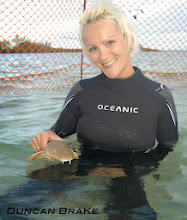
When I finished speaking about nurse sharks we asked if anyone wanted to hold the shark.  I am happy to report that despite the initial hesitation, everyone held the little shark and was thrilled to learn so much about them. We moved onto the lemon shark and as Duncan was talking about them, the stingray decided it needed some attention and swam right onto Judy’s toes. She was bit startled, but no longer fearful. Curiosity and facts had replaced fear. YES! Duncan showed the features of the lemon shark and we chatted about the mangrove nurseries here in Bimini and the fact that juvenile lemon sharks are social and have buddies. This is one of my favorite facts, that and the umbilical scar (“belly button”), to share with people. Words like nursery, baby and belly button definitely change the conversation when referring to sharks. We finished the tour with a group photo and continued to answer questions. Everyone was really excited and the conversation continued later that evening at dinner. My heart melted when Sandy said they had jumped in to swim with dolphins that afternoon, something she would have been too afraid to do before we taught them about the sharks. I have watched those little sharks catalyze a thought change regarding sharks in a lot of people and if you are ever in Bimini you definitely need to visit the lab! If you are not a fan of sharks, you might just become one after the visit!


While we were at the lab Rachel, TJ and Jack (all lab managers) cruise over with a special surprise; a baby eagle ray. We see tons of eagle rays both solo and in schools, but I have never seen one this small. Our friends got to see the little guy and learned a bit more about another one of Bimini’s amazing creatures. The lab put the eagle ray in a large holding pen and had someone keep an eye on it. The visiting course students were able to snorkel with it, again a rare treat. One of the best things about Bimini is that you never know what you are going to see on or in the water! After our friends left we spent a little time with the eagle ray. They are the most graceful animals in the water, gliding effortlessly. This one had a wingspan of about 12-16 inches. This is not much larger than when they are born, so this one was definitely less than a year old.

Juvenile spotted eagle ray

Our Sharks4Kids spotted eagle ray poster
We then headed out to film some upside down jellyfish (cassiopeia) , not the most exciting thing, but still a cool animal. We finished filming and saw a few juvenile lemon and nurse sharks cruising at the edge of the mangroves before heading across the lagoon for home. We stopped for a minute at the edge of a mangrove island to jump in the water and cool off. I noticed a lemon shark behind the boat. I jumped in to have a look and saw two. They appeared to be 1 to 1.5 meters in length and we knew Rob, a PhD student doing his research at the lab, was looking for that size. We radioed him and started to throw some bait in the water to keep the now 5 sharks around. Rob arrived with his crew and put their rods in the water. Within a few minutes they had a shark and got it in the holding tub on the boat. Juveniles are placed a in a large tub with a bilge pump to keep the water moving and the water is replace often so they have a sufficient amount of oxygen.


Lorna, the assistant lab manager, scanned the shark with a PIT tag reader and it beeped. The PIT (Passive Integrated Transponder) tags are injected into every lemon shark caught by the lab and give valuable data about the life history of these animals. They are similar to a microchip your cat or dog may have and give each shark an ID. This is a simple method to gather data about an animal over time. Rob decided the shark was not large enough for what he needed and released it. We decided to call it a day and headed in.
PIT Tags Image: Destron Fearing

I love Bimini and I love days like these.

Wednesday, September 4, 2013

Shark Products: Beware and Be Warned


There is a disproportionate percentage of the population that seems unaware of the shark killing, consumption and demand lurking in their own backyard. Yes, the demand for shark fin soup is pushing many species to the edge, but this is not the only issue and it is not something happening only in Asian countries. Rainforest destruction, coral reefs dying, global warming and pollution; it can all seem overwhelming and the easy stance is, “ well it’s not happening where I live, so what can I even do.” When it comes to shark conservation I guarantee there is a lot you can do and yes, it is happening where you live!

You do not need to be an expert, scientist of even a diver to make a difference; we can all do something. You might be sitting in Colorado right now thinking, no way, there is nothing happening in my backyard that is impacting our oceans. Wrong! Have you checked out any natural or Asian grocery stores? Been to Target or a local fish market? Many different marine animals are used in ancient medicine including ground up shark cartilage, but you can also find it in pill form at modern stores like GNC and Target. See where I am going? This isn’t just happening in a far away land, it is happening everywhere.


I wrote a blog a few years ago about tourist shops in South Florida and their propensity for selling shark jaws and sharks in jars. Yep, apparently nothing says, “I went to the Sunshine State,” like a shark fetus in a jar. Duncan and I walked into at least five stores in South Beach and each one was the same, hawking the same dried animal parts. Lemon shark jaws put me over the edge because the state of Florida had recently established a law protecting them. I asked a clerk if he knew where they purchased animals parts from and he got the manager. I was told a company called Holiday Souvenirs was the distributor for not only this store, but also most of the shops along the beach.


When we got home I did some research and contacted the Fort Lauderdale based company. It took a few attempts to get connected to a person that was willing to answer my questions and actually “knew” the answers. The conversation started out polite and I expressed my consumer concerns about the sale of lemon shark jaws. I asked the woman on the other end if she was aware these sharks had recently gained protection in Florida waters. She assured me they came from “overseas” making everything okay! Ha! I pushed further asking where overseas? Overseas was her answer, which clearly she felt should satiate my inquiry. I asked how they were acquired? Apparently, wait for it, poor fishermen catch sharks to feed their families and the jaws are just a byproduct they sell to make a little extra money. Wow, a lot of poor fishermen “overseas,” are trying to feed their families and this company is being very civic by purchasing those jaws. I continued to push. “ So thousands of shark jaws are only collected as a byproduct from poor fisherman? “

“Yes!”

“What about the shark fetuses?”

“ Sometimes the sharks they catch to feed their families are pregnant and they collect the fetuses as another byproduct to make a little extra money.”

“ I see, so you guys are really doing a great service for these poor fishermen?”

“Yes, yes we are.”

I then jumped on my soapbox, ever so politely, and informed the woman about the current status of global shark populations. There is no way they are stocking shelves across the country with shark jaws and jars by just getting them as byproducts. The sharks are being targeted and yes, other parts may be sold, but it not the sob story she was telling me. She got flustered and finally ridiculed me for not caring about these poor people and hung up. I took a breath and waited. Calling back would not make a difference, but hopefully I had gotten into her head and maybe she would think a little differently. She is only a pawn and not actually the person giving the green light on purchases. I made a few other calls and the story was mostly the same, but her human-interest story was the highlight. I don’t blame her because she was obviously drinking the Kool-Aid being served to her, but it was insightful.

If you look at Holiday Souvenirs or Wonders of the Sea, you will see a wide range of dried and creepy animals. I grew up in Maine and deer heads or antlers are quite popular as interior décor, but I have never been a fan. Dried or dead animals are not something I want in my home and whether sharks are in trouble or not, who wants and animal fetus in a jar as trinket on the mantel?


All of this relevant because you can speak up! As a consumer you have the right to know where products are coming from. Think about this the next time you go to the fish counter at your grocery store or the local fish market. Ask what the fish is and how it was caught. Now the teenager working the counter might not know, but someone at that store should or they should know where you could find out. You are not being rude or inappropriate; so do not be afraid to ask. Same thing at restaurants, find out where they get their fish? Is it really what they say it is? A recent study done by Oceana found a massive proportion of seafood in the United States mislabeled.

“Nationally, the worst offenders were sushi venues, where fish was mislabeled an average of 74% of the time, followed by restaurants with 38%, and grocery stores at 18%. “ I want to know what I am eating, don’t you?

You might be wondering how asking can make a difference? It will. Yes, you are only one person, but it adds up and one person becomes twenty very quickly and so on. Share this information with friends and family and encourage them to do the same. Write a letter or make a phone call to voice your concerns. They might be able to ignore one call or one email, but word spreads and they cannot ignore an onslaught of concerned consumers. I have seen restaurants pull menu items because of barrage on social media. One comment from one person multiplied and a change was made.

These are all actions anyone can take, but remember to be polite and do your research. Flying off the handle like a crazy person is not going to get them to listen. Believe me this is easier said than done especially when you are up against ignorance, as they say,” you can’t argue with stupid.” You will get frustrated and it might seem like a waste of time, but I assure you it is not. If you are not sure of what to say or write, there are a lot of sources online that can help. Make sure you get information and seek guidance from a reliable source. I was recently on twitter chatting about accurate information when it comes to shark education and conservation. I agree that people do not need to be experts or scientists to do their part for our oceans, but please get your information from a reliable source. There are so many groups and people popping up on social media it can be hard to wade through the muck and find the truth, but I assure you it can be done.Science and research provides facts to strengthen the fight to protect our oceans, but the masses can take this information and use it to change the demand.

Below I have listed some sites you can contact to express your concerns about shark conservation as well as sources to gather reliable information about sharks, shark conservation and how you can help.


Recommended Websites


Bimini Biological Field Station

Guy Harvey Shark Research Institute
RJ DUNLAP
Shark Savers
Shark Trust


Stores & Restaurants to Contact

Holiday Souvenirs hsshells@bellsouth.net
Wonders of the Sea websales@sealifegifts.net
Wings Beachwear
Hilton Hotels


For HI RES copies of these posters please email me sharkyjillian@gmail.com


Tuesday, August 6, 2013

Bimini Shark Week with Deano Cook


In my life every week is Shark Week, but there are definitely weeks more intense than others. A recent visit from photographer, painter, tattoo artist and good friend Deano Cook was one of those weeks. I met Deano in 2007 when I saw him tattooing marine artist Wyland at a convention. As a lover of sharks and tattoos, I knew right then and there I had to have a piece of his art on my body. It took six years of busy dive schedules and missed attempts, but we finally made it happen when he came to visit us in Bimini.

Bimini is one of my favorite places on the planet and I absolutely love sharing my home with people, especially those that have a real passion for the ocean. We wasted no time getting in the water and headed out for a Caribbean reef shark dive. The site here is pretty shallow, which is nice change from most of the deeper shark dive sites throughout the Bahamas. We had about eight reef sharks cruise through and two little blacknose sharks. They are considerably smaller than the reefs, but have no problem getting right in the mix. We spent an hour with these beauties before heading due south in search of stingrays.

IMAGE: DEANO COOK


Honeymoon Harbour is Bimini’s smaller and less commercialized version of Grand Cayman’s Stingray City. We anchored just off shore and it was only a matter of minutes before the troops came flying in. For years, visitors have interacted with a large population of Southern stingrays and the occasional lemon, blacktip or nurse shark at this location and it is a favorite spot for most visitors. On our last few visits a very precocious nurse shark has made an appearance and seems to have no problem begging for a snack amongst the rays. Animals are really clever and I love seeing large species interact with each other. I know nurse sharks do not garner a lot of excitement from diehard shark enthusiasts, but I love them.


Another regular, a ray we affectionately call, “ The Blanket,” showed up to welcome Deano to the island. This female Southern stingray is probably five feet across and has no etiquette when it comes to interacting with people. She is large and in charge, sitting on your lap, knocking you over and completely smothering your camera. She is definitely the matriarch of the group and quite assertively lets everyone know this. We spend a lot of time with these animals and it is incredible to see their personalities become more defined the more time you share with them. Yes, they are all the same species, but they are definitely not cut from the same mold. I always get the giggles at this site because it is impossible to not laugh when a stingray is tickling your toes.


We returned to the reef sharks the following day and got some great shots with our new Oceanic and Lavacore gear. Our dive was cut short by some nasty squalls moving in. They come is fast and hard during the summer months in Bimini and can quickly knock the visibility to zero. They are so pronounced and confined however, you can usually avoid the brunt of them. We headed out and actually lost power in our port engine, which kicked us around hard on a large swell and sent Deano flying across the boat. We turned to head south towards the medical clinic on Cat Cay. What should have been a fifteen-minute ride, took over an hour with the wind and swells. We arrived and Deano was able to move around, but had definitely sustained an injury to the ribs. We made the slow cruise back to South Bimini and headed to the clinic because the doctor was not available on Cat Cay. The doctor told him he should get x-rayed in Nassau, but Deano was not going to miss out on diving, sharks and tattooing.

We took it easy the next day, but Deano did not want to miss out on opportunities, so we made it work and headed to the Sharklab. We spent time in the pens with some juvenile lemon and nurse sharks and Deano was able to get some images as well as hold a few of the little guys. It really is a special experience and I never get tired of hanging out with those cute little babies. Sharing miniature versions of the ocean’s might predators is a powerful tool for education. Deano is a shark lover, but for many people seeing how “cute” a shark can be really changes their perception about these animals.


The mangroves were next on our list because they are the heart and soul of Bimini and a place everyone should take the time to visit. It may not seem exciting, but the amount of life above and below the surface is remarkable. We showed him the mega resort on the north island and explained the damage that has been done and the impending threats that are looming. Bimini is not a bustling metropolis, nor should it ever be, but the quiet of the mangroves really takes you away from the hustle and bustle of everyday life. I am not sure how excited Deano was about the mangroves to start, but within minutes he was raving about how incredible they were.


As if on cue, a juvenile lemon shark swam out in front of our boat and cruised through the gin clear water just ahead of us. We know the sharks use the mangroves as a nursery for the first 3-4 years of their life, but it is always exciting to spot one. It was really awesome to see how excited Deano got as well. A tree-lined channel is not where you expect to find baby sharks and these encounters are always surreal. We continued onward spotting schools of snapper, small conch and birds. We paused for pictures and to talk about this incredibly diverse forest and why it is vital for Bimini and the oceans of our planet. These nurseries are critical for healthy populations of not only sharks, but snapper, conch and lobster; all major components of the Bahamian economy.

We hopped in for a snorkel in Bonefish Hole and found schools of silversides dancing in the sunlight, giant stingrays buried in the sand along the edge of the mangroves, hundreds of snapper, tiny butterfly fish and sergeant majors peeking out from behind the roots and dozens of small lobster taking refuge under mangrove root ledges. This forest is literally overflowing with life. I watched a crab eating a snail, while delicately balanced on a single branch. The weather was rough at the edge of the channel, so we didn’t spot any turtles for Deano, who was desperately hoping to catch a glimpse of the juvenile greens that hang around, but regardless the day was amazing.


The week was going by way too fast, like it always does when you are doing what you love and it was time to get down to business. We had spent evenings deciding on the size and Deano enjoyed an ocean view office to do some stenciling. I will admit I was hesitant to have a large back piece, but I knew a lot of the detail would be lost if we went too small. Deano was patient as I taped on the images and then looked at pictures of them on my back. We finally compromised on a size and he laid the stencil on my back. Although he started with a stencil, the true artwork is in his eye as he free hands the shading and brings the animal to life. I did not want a shark tattoo, I wanted a portrait of the most amazing animal on the planet; Deano Cook made this a reality. He is not just a tattoo artist, but someone who has spent time with these animals getting to know how they move, how they act and the tiny intricacies that make them unique and beautiful. As we discussed the details to emphasize on the great hammerhead we were continuously on the same page. The eye, the curve of the tail and even a biopsy notch in the dorsal fin; he brought this magnificent creature to life.


This marks my 7th tattoo, but it the first large piece of artwork I have ever had. As I sat on the stool in the make shift tattoo studio we created in our living room, I was excited and nervous. There is such a rush when you get inked. It hurts, yes it hurts a lot and people are full of crap if they say it doesn’t. Deano spent six hours the first day and then we enjoyed grilled conch prepared by my amazing husband. We talked about sharks, adventures and chasing our dreams. Deano and I had never dived together, so the days building up to the tattoo were really special and were definitely brought into the piece. Deano is a friend painting his love of sharks using my back as a canvas. I say, “using,” because we are not done.

We started earlier the next day because we had “Lobster Fest 2013,” to attend that evening and we didn’t want to miss out. Lobster season had opened the day before and our good friend and neighbor Leesa was preparing several dishes including HANDMADE lobster ravioli. Another 5 hours of pain, stories, art and ocean passion went into my back. We rocked out to a great band called Slightly Stupid and some Maroon 5. Lobster fest was beyond words and we all really enjoyed another random and epic night on the island. Bimini is small, but always full of impromptu moments of awesomeness with great people. I love this island!

A final hour long session on his last day left the total at 12 hours of work creating an incredible portrait of, in my opinion, the most magnificent animal on Earth. 12 hours is pretty is a long time, but he did it with FRACTURED RIBS! Yeah, he is a rock star. Diving, playing with sharks and tattooing while he was busted up; now that is dedication. I have to say I was nervous about the size of the artwork, but looking at it now and the way it flows with my back, I couldn’t imagine it any different.


Thank you Deano for an absolutely epic BIMINI SHARKWEEK. Cannot wait for our next adventure.

Monday, August 5, 2013

Shark Week: Shark Babies


Sharks are apex predators that rule the oceans of the planet, but even the largest shark begins life small. Most people only see the gnashing teeth or the massive beast strung up as a fisherman’s trophy, never stopping to think about how the story starts. If a shark reaches sexual maturity (8-12 years on average) they must find then find mate. In the case of lemon sharks they have a gestation period of 12 months before giving birth to live young. The female essentially beaches herself on a high tide, getting her pups as close to the protection of the mangrove forest as she can.


The pups are thrust into a dangerous world and very few will survive to see their first birthday. Sharks, barracudas and even adult lemon sharks will happily make a meal out of these babies, so it is critical for them to find shelter amongst the roots and in the shallows. It is here in this nursery the sharks will spend the first 3-4 years of their life, honing their skills for survival in the open ocean. Juvenile nurse sharks, conch, lobster and snapper also use the protective roots of the mangroves as a nursery area until they too, are ready to move into deeper water. Sharks are the last animals you would expect to find in a forest, but above and below the surface the mangroves are vital for the survival of countless species across the planet.


For over twenty years Doc Gruber and the Bimini Biological Field Station have been studying these tiny predators in the mangroves and lagoons of Bimini in the Bahamas. The Sharklab has done ground breaking research proving these sharks are highly social and even have their best friends. They have also studied the devastating impact the development of a mega resort has had on juvenile lemon shark populations in Bimini. The mangroves are the heart and soul of these tiny islands and without them the people and the ecosystems around the island suffer.

Sharklab director Dr. Tristan Guttridge with a juvenile tiger shark

Sharklab observation tower

A shark with a transmitter being observed in the shallows

I love sharing these little guys with people because it shows them a different side of sharks. Even the most fearful people can find a new appreciation for these incredible animals. It gives them a change of perspective when they are looking at a very small and very vulnerable creature. Don’t get me wrong they still have teeth and still behave like a shark, but seeing the tiny belly button scar of a lemon shark or the spotted belly of a baby nurse shark, will soften even the harshest critic.


As you watch Shark Week and see the iconic shots of great whites with mouths wide open and laden with teeth try and think about that shark when it was small. There is a lot more to the story than what you are getting a glimpse of.
Happy Shark Week

Monday, April 15, 2013

Bimini BULL 'ish: Shooting Fish in a Barrel


Duncan and I spent an amazing day on the water to celebrate our one year wedding anniversary and decided to head to the north island for dinner. We sat on the Big Game restaurant deck and enjoyed our cocktails as we watched the sun slipping away. The fish-cleaning tables were bustling with activity as several guys cleaned the day’s Mahi Mahi catch. We watched as they leaned over the railings and pointed, no doubt spotting some of the bull sharks that cruise the area looking for free scraps. For decades bulls sharks have swam into the channel between the islands and gotten a free meal from fisherman cleaning their catch. The Sharklab has been collecting valuable data from these animals for years through their tagging program.


Tagging a bull shark in Bimini IMAGE: Grant Johnson


This year Big Game launched an operation allowing people to see these incredible animals up close from the comfort of a shark cage. No, it is not conditioning the sharks to associate people with food, it is simply allowing people a safe viewing window of a phenomenon that has been happening for year. We watched as one guy grabbed a rod and his fighting belt. I looked at Duncan and we knew what this idiot was planning. The deep-sea rod with high-test tackle was not designed for catching snapper, but was ideal for sharks. All of a sudden everyone was shouting and running down the dock. He had hooked a shark and was now trying to figure out what to do. Guys were scrambling to grab cameras in order to capture their latest Facebook status update in an attempt to prove how tough or manly they are.

I headed for the dock and Duncan headed for the office. The guy was shouting, “it’s in the pilings,” as I made my way over. I quietly asked one of the guys what was going on and he smiled as he shared with me the excitement of the bull shark on the line. I could see the shark in the distance and walked back to the office. I had to bite my tongue because in their drunken state of machismo, these men would most definitely be argumentative and this accomplishes nothing.

Duncan was explaining the situation to the security guard as I entered the office. We made our way back to the deck and watched as she went to speak with the men. The shark had by this time broken the line and was now, most likely, sporting some new and unnecessary jewelry. You may be wondering why I am writing about this and there are 3 simple reasons.

1. This marina is clearly labeled as Shark Free with signs posted in several locations.

2. The Bahamas is a Shark sanctuary and fishing for sharks is illegal. There is a sign posted on the fish-cleaning table that clearly states this.

3. Fishing for sharks at a shark research & diving site is pathetic and completely disrespectful to the animals, the research and the island itself.

Here is what Bimini Bull Run had to say in response to our report.
“We just got word that someone deliberately hooked one of the wonderful sharks at Bimini Big Game Club yesterday. The shark broke the line but still has a hook in it, which is TOTALLY unacceptable.

These persons willfully chose to ignore:

1. Multiply Shark-Free Marinas Signs

2. Multiple Active Shark Zone Signs

3. Multiple Area Under Surveillance Signs

4. 220 feet of chain link fencing, 100 feet of wooden fencing

5. One ACTIVE camera on a 60 foot mast

6. An informational website that clearly states no fishing (SFMI)

We will be taking further steps to prevent ANYONE from fishing sharks at the BBGC. At the time security was called by the locals who witnessed the event (thank you!) and the shark fishing ended.

Due to the newly installed fencing at BBR it has made shark fishing much harder (you really have to try) but yesterdays sad event showed us that there is more educational work to be done and more outreach that could happen.

Change will happen but sometimes people who feel entitled will ignore every sign posted and only stop poor behavior when confronted."


*****UPDATE*****

The vessel these men were on has been banned from Bimini Big Game Club! Bimini LOVES Sharks


Sunday, March 3, 2013

2013: The Year of the Great Hammerhead Shark

As I write this, CITES CoP16 is underway. CITES, the Convention on International Trade in Endangered Species of Wild Fauna and Flora, is an international agreement between governments around the world. The goal is to ensure that the multi-billion dollar international trade of wild animals and plants does not threaten their survival. CITES offers protections for over 30,000 species across the globe. Countries voluntarily join, but once a member they are legally bound to uphold the convention. This year the 16th meeting of the Conference of Parties (countries) is happening in Bangkok, Thailand and a proposal to include scalloped hammerhead sharks (Sphyrna lewini) in the Appendix II listing has been submitted by numerous countries including, Costa Rica, Ecuador and 27 member States of the European Union. Great and smooth hammerhead sharks are being included in this listing because their fins look very similar when traded. Oceanic white tip sharks, porbeagle sharks and manta ray proposals have also been submitted.

2013 has certainly become the year of the great hammerhead shark, especially on the tiny island of South Bimini in the Bahamas. For nearly a decade the Bimini Biological Field Station (Sharklab)
and its staff have been developing sites to dive with and tag these amazing creatures. From January through March, the great hammerheads frequent these crystal clear waters and can be n close proximity to the coastline. Until this year, this aggregation had managed, for the most part, to stay off the radar. This created an ideal research and diving venue, uninfluenced by outside factors. This has all changed this year and the, "cat is out of the bag," so to speak with everyone and their uncle motoring to the shores of Bimini to have their moment in the world’s newest shark diving Mecca.

The shark diving community is small and the Internet has made the world even smaller, so in a short period of time news has spread to the far reaches of the globe in the form of images, social media posts, videos and blogs. Sadly, it has also not taken much time for bickering among boats, claims of discovery and touching/grabbing of the sharks to happen. No one owns these sharks, but the sharks, the scientists who study them and the island they are swimming around, should all be respected. I have shared two letters in a previous post about hammerhead shark diving protocols and encourage people to read them. The world deserves to see these animals and the more positive press and education that is spread, the better their chances of survival.

My first hammerhead encounter happened in 2007 off the coast of Key West, Florida. Since then I have only had a handful of encounters both diving and tagging these animals, but they have remained my favorite animal on the planet without question. The conservation media company my husband and I run has a hammerhead in the logo, we each have hammerhead tattoos that we got before we ever met and our wedding rings have 2 hammerheads engraved on them; we love these sharks.


The crystal clear water of Bimini and the shallow depth, make this an ideal place for photo and video; probably the biggest draw for the masses now flocking to Bimini. The sharks cruise in from the haze and circle around the bait. These charismatic predators are bold, but not aggressive or fearful. They have comical faces, with their mouth on the underside and large cartoon like eyes. They appear to be laughing at a joke or smiling for the camera. Power and grace, with a Cheshire cat smile. No, they do not have the characteristic sleek body or head sharks are known for, but even people who do not know much about sharks can identify a hammerhead.


Sadly, the rare and elusive nature of these creatures, which has catalyzed a global interest in photographing and filming them, is also the reason why research to better understand them is absolutely critical.

I feel truly blessed to have spent so much time with these magnificent animals and I hope that each and every person that slips beneath the surface around Bimini realizes how fortunate they are as well. It is not about getting the shot or filming in 4K; it is about sharing with the world why these animals need protection. Each image, each video clip, each blog, each story shared with friends, is so much more than just those things; it is an opportunity to spread awareness, educate the world and help make sure future generations can know the indescribable beauty of having a great hammerhead swim past.